Stream processing vs batch processing: A Practical Decision Framework for 2026
TL;DR: Key Takeaways
- Latency is Financial: The choice between stream and batch isn't technical—it's financial. Only choose streaming if the cost of a 1-hour delay > the 5x operational cost of streaming.
- The "Good Enough" Middle: Micro-batching (processing in seconds/minutes) delivers 90% of real-time benefits at 50% of the cost/complexity of pure streaming.
- Operational Reality: Streaming is a 24/7 commitment requiring senior engineering talent to manage state and out-of-order events. Batch is simpler, idempotent, and cheaper.
- Hybrid Future: The most resilient platforms use a hybrid approach: Streaming for immediate operational alerts (fraud, pricing) and Batch for comprehensive, accurate reporting.
- TCO Matters: Don't just look at cloud bills; factor in the on-call burden and "irreducible complexity" of debugging distributed streaming systems.
The debate over stream processing vs. batch processing is fundamentally a business decision disguised as a technical one. Streaming systems process data in real-time as it arrives; batch systems process it in scheduled, finite chunks. The right choice isn’t about which technology is “better”—it’s about whether your organization can generate more revenue from immediate action than it would save by waiting. This guide provides a pragmatic, no-fluff framework for making that call.
The Decision Framework: When Does Latency Justify the Cost?
Before evaluating any technology, you must quantify the true business cost of data latency. This isn’t a vague exercise; it’s a critical financial calculation. Map your key business decisions—like detecting fraud, allocating inventory, or triggering personalized offers—directly to revenue impact.
Ask this question: If a one-hour delay in receiving data for a key decision costs the business more than $100,000 annually, then streaming’s 3-5x higher operational overhead versus batch is likely justified. If the cost is lower, or the decision doesn’t require sub-minute action, batch or micro-batching is the more financially sound choice.
The core principle is this: Only stream when a human or system must act within minutes. Real-time processing ROI materializes solely from immediate actions like blocking fraudulent transactions or making dynamic pricing adjustments. For analytics, monitoring, or ML features without sub-hour decision windows, batch or micro-batch suffices and scales cheaper.
Use business Service Level Objectives (SLOs) to drive this decision. Define freshness requirements explicitly (e.g., 99% of decisions need data <5 minutes old). This prevents over-engineering streaming where hourly batch meets the SLO, freeing budget for higher-impact modernizations.
The Irreducible Complexity of Streaming
Understand that streaming complexity is irreducible—you cannot engineer it away. When you choose streaming, you must budget for 4-6x the engineering effort compared to a batch equivalent.
Implementing exactly-once semantics, state management, watermarking for late data, and ensuring replayability are hard computer science problems that demand senior engineering talent. In contrast, simpler idempotent batch jobs can often be built and maintained by mid-level engineers. This talent and effort delta is a primary driver of Total Cost of Ownership (TCO).
Decision Matrix for Processing Models
This matrix provides a high-level summary to guide your initial thinking.
| Processing Model | Optimal Latency | Typical Use Case | Relative Cost & Complexity |
|---|---|---|---|
| Batch Processing | Hours to Days | Financial Reporting, ETL, ML Training | Low |
| Micro-Batching | Seconds to Minutes | Dashboard Refresh, Log Analytics | Medium |
| Stream Processing | Milliseconds to Seconds | Fraud Detection, Dynamic Pricing | High |
If your needs fall into the “High” cost bucket, you are in streaming territory. If they fall into “Low” to “Medium,” a batch or micro-batch approach is the more sensible starting point.
Understanding Core Architectural Differences
Batch and stream processing operate on entirely different philosophies that dictate their architecture. One is designed for throughput and comprehensive analysis on bounded data; the other is engineered for low-latency, continuous reaction to unbounded data.
Batch processing works with bounded datasets—finite collections of data with a clear start and end. Think of it like closing the accounting books for a month: you collect all transactions for that period, run a large processing job, and produce a definitive report. The architecture prioritizes efficiency and throughput over speed.
Stream processing deals with unbounded datasets—infinite, constantly growing streams of events that never end. An event-driven architecture processes each event as it arrives, demanding continuous computation and sophisticated state management over time.
The Batch Processing Model
The batch model is straightforward and predictable. Data is collected over a period and stored in a data lake or file system. On a schedule, a processing engine like Apache Spark activates, reads the entire dataset, performs transformations, and writes the results to a destination.
- Data Scope: Large, static datasets (e.g., all of yesterday’s sales).
- Execution: Triggered on a schedule (e.g., nightly at 2 AM).
- State: Mostly stateless. Each run is an independent, isolated execution.
- Ideal Workloads: Financial reporting, ETL for data warehouses, and training large-scale machine learning models where completeness trumps speed.
Batch processing is the foundation of data engineering. Systems like Apache Hadoop were designed to process petabytes of data in discrete jobs. The historical trade-off is high latency—answers are only available after the job completes. Rivery.io offers more detail on this established approach.
The Stream Processing Model
A stream processing architecture is event-driven and “always-on.” It continuously ingests data from sources like Apache Kafka and processes events individually or in small windows. This model must handle real-world complexities that batch systems can often ignore.
A key challenge is managing the difference between event time (when an event occurred) and processing time (when the system observed it). Handling out-of-order and late-arriving data requires sophisticated techniques like watermarking to ensure correctness.
Furthermore, most valuable streaming jobs are stateful. For example, calculating a running count of fraudulent transactions over a five-minute window requires the system to maintain state (i.e., remember previous events). This single requirement adds a massive layer of operational complexity. Unchecked state can grow infinitely, leading to Out Of Memory (OOM) failures and ballooning costs—a primary reason robust streaming systems require senior engineering talent.
The Pragmatic Middle Ground: Micro-Batching as the Default
For many organizations, the leap from hourly batch to pure, millisecond-latency streaming is unnecessary and cost-prohibitive. This is where micro-batching provides a practical, cost-effective bridge.
Micro-batching engines like Spark Structured Streaming collect incoming data into small, discrete windows (from seconds to a few minutes). The engine then processes these tiny “batches” sequentially, creating a near-real-time flow without the full operational burden of a true continuous streaming model.
This approach provides a powerful balance: significantly improved latency over traditional batch, while sidestepping the most difficult aspects of streaming like complex state management and event-time processing.
When “Good Enough” Latency Is Great for Business
Micro-batching is ideal for use cases where sub-minute data freshness is sufficient. This includes refreshing operational dashboards, ingesting application logs for analysis, or updating recommendation engine features. In these scenarios, the business value difference between data that is 30 seconds old versus 300 milliseconds old is often negligible.
The difference in cost and engineering effort, however, is massive.
Adopt micro-batching as the default bridge: For 80% of use cases needing “near-real-time” (minutes, not milliseconds), triggered micro-batches deliver 90% of streaming benefits at 50% of the complexity and cost of pure continuous streaming.
This pragmatic approach delivers timely insights for the vast majority of business needs without the inherent risks of a pure stream processing architecture. It is a strategic choice that optimizes for both speed and sustainability.
Comparing Total Cost of Ownership and Operational Burden
Latency is an easy metric to focus on, but the make-or-break factor in the stream processing vs batch processing decision is the Total Cost of Ownership (TCO). The operational burden and financial commitment required for a robust streaming architecture are far greater than for traditional batch systems.
Streaming infrastructure is a 24/7 commitment. Unlike scheduled batch jobs that can spin resources up and down, streaming clusters must be perpetually online, highly available, and fault-tolerant. This constant uptime directly translates to higher cloud compute and storage costs.
The Hidden Costs of Real-Time Operations
The true cost of streaming extends far beyond server instances. It includes debugging out-of-order events, managing stateful operations without causing memory failures, and guaranteeing exactly-once processing semantics. These hard problems require senior engineers who command higher salaries and bear a significant on-call burden.
Batch pipelines are comparatively simpler. Their idempotent nature (rerunnable without side effects) makes troubleshooting straightforward, often manageable by mid-level engineers during business hours. This difference in personnel and support is a huge driver of streaming’s higher TCO. Before diving in, it’s wise to understand the fundamentals of how to build data pipelines.
Evaluate total ownership cost, not just latency. Streaming clusters run 24/7 with high availability needs, often 5-10x more expensive than scheduled batch. Factor in on-call burden, debugging out-of-order events, and vendor lock-in before committing.
A Practical Cost Breakdown
The table below breaks down often-overlooked operational costs.
Comparative Cost Analysis: Batch vs. Streaming
| Cost Factor | Batch Processing | Stream Processing | Key Consideration |
|---|---|---|---|
| Infrastructure | Scheduled, transient clusters; can scale to zero. | Always-on, high-availability clusters. | Streaming’s constant resource allocation drives up baseline costs significantly. |
| Personnel | Often maintainable by mid-level data engineers. | Requires senior/staff-level talent for state management and fault tolerance. | Higher salaries, steeper learning curve, and greater competition for talent. |
| On-Call Burden | Low; failures can often wait until business hours. | High; requires 24/7 monitoring and immediate response. | Direct impact on team burnout, morale, and operational overhead. |
| Debugging | Simpler and isolated; jobs are idempotent (rerunnable). | Complex; involves timing, state, event order, and distributed systems. | Debugging streaming issues is non-trivial and can consume days of senior engineering time. |
Batch processing offers a predictable and contained cost model. Streaming introduces operational and financial complexity that requires a clear, high-value business case to justify.
Designing for Performance and Scalability
When implementing either model, the key metrics are latency and throughput. Batch processing is designed to maximize throughput—processing massive, bounded datasets as efficiently as possible. Streaming is designed to minimize latency for unbounded data flows.
A well-designed streaming system can process events with latencies under 200 milliseconds on modern cloud platforms. A batch job providing the same insight might take hours. This speed comes at the price of engineering complexity, particularly around state management and out-of-order data. Digging into performance benchmarks and design patterns is critical for understanding these trade-offs.
The Hidden Cost of Stateful Streaming
Low latency is powerful, but it introduces a major operational risk: state management. Use cases like windowed aggregations and joins require the system to remember past events. This “state” must be stored, and if not managed aggressively, it can grow without bounds.
Unchecked state is notorious for sinking production streaming deployments by causing Out Of Memory (OOM) failures and ballooning storage bills.
Stateful streaming explodes costs if unchecked. Windowed aggregations and joins require persistent state. Implement aggressive TTLs, compaction, and RocksDB tuning early. Unchecked state has sunk multiple production streaming deployments with OOM failures and ballooning storage bills.
Practical Strategies for Managing State
To build a scalable and stable streaming application, you must proactively manage state from day one.
- Implement Aggressive TTLs: Set a strict Time-to-Live on all state data. This automatically evicts old information, preventing infinite state growth.
- Tune Your State Backend: For frameworks like Apache Flink, you must tune your state backend (e.g., RocksDB). This involves configuring memory allocation, caching, and compaction to balance performance and storage footprint.
Mastering these techniques is essential to realizing the benefits of real-time processing without falling victim to its most common and costly failure modes.
Building Future-Proof Hybrid Architectures
In the stream vs. batch processing debate, the winning strategy for enterprise scale is not to choose one, but to build a hybrid architecture that leverages both. The most resilient data platforms use each model for what it does best.
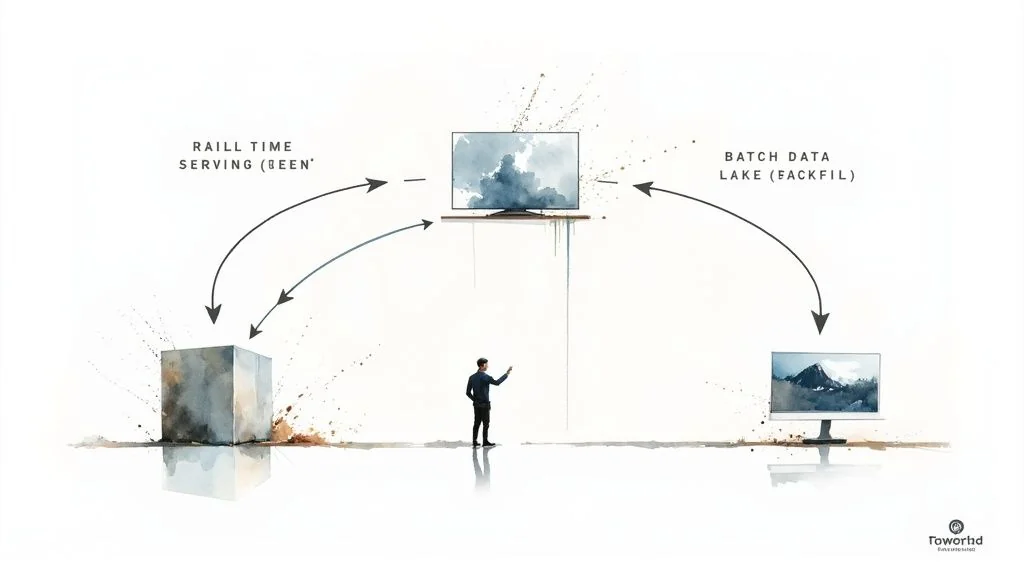
This approach involves running streaming pipelines for low-latency serving layers (e.g., fraud alerts, real-time dashboards) while using batch processes to backfill and correct data for accuracy-critical workloads like financial reporting or ML model training.
The Power of a Unified Approach
The biggest risk in a hybrid model is creating fragmented pipelines with separate codebases, which doubles the maintenance burden and leads to inconsistencies. To avoid this, prioritize unified processing engines like Databricks Lakeflow or Apache Flink, which support both paradigms. This allows you to write business logic once and deploy it in either streaming or batch mode.
A unified strategy future-proofs your data platform. A pipeline that starts as a daily batch job may need to evolve into a near-real-time micro-batch process in 2-3 years. With a unified engine, this is a configuration change, not a complete rewrite.
Design for replayability from day one. Treat logs as the immutable source of truth (e.g., Kafka topics with long-term retention). This enables easy backfills, bug fixes, and schema evolution. Batch reprocessing of historical data becomes trivial, turning a streaming “liability” into a reliability asset.
Architecting for Reliability and Evolution
By preserving the raw event stream, you gain the ability to reconstruct state or correct errors. A bug in your streaming logic no longer causes permanent data corruption. Instead, you deploy a fix and replay historical events through the corrected pipeline.
This design makes your batch and streaming layers complementary:
- Streaming Layer: Provides immediate, provisional insights for operational decisions.
- Batch Layer: Reprocesses the same event data daily or hourly to produce a canonical, corrected version of the truth, overriding any inaccuracies from the streaming pipeline.
This “lambda-like” pattern delivers both speed and accuracy. To make it work seamlessly, strong orchestration is key. Understanding different data orchestration platforms is crucial for building a cohesive system that can adapt to future business needs.
Frequently Asked Questions
Here are straightforward answers to common questions that arise when choosing between stream and batch processing.
When Is Pure Stream Processing Absolutely Necessary?
Pure stream processing is only mandatory when an automated system or a person must act on an event within milliseconds or seconds. The classic examples are real-time fraud detection (blocking a transaction before it completes) and dynamic pricing for e-commerce or ride-sharing (adjusting prices instantly based on live demand).
If the decision window is measured in minutes, not milliseconds, micro-batching is almost always the smarter, more cost-effective, and operationally simpler choice. Only choose pure streaming when the business value of immediate action clearly justifies the significant operational overhead and 5-10x higher cost.
How Do I Migrate From a Batch to a Streaming Architecture?
Avoid a “big bang” migration. The safest method is a phased, parallel approach.
First, build the new streaming pipeline to consume the same source data as your existing batch job. Run it in “shadow mode” for a period, operating both systems concurrently. This allows you to meticulously compare outputs to validate the logic, performance, and integrity of the new stream.
Once you are confident in the streaming results and have robust monitoring in place, you can begin switching downstream consumers to the new pipeline one at a time. This process is far smoother if you use unified platforms that support both paradigms, as the migration can be as simple as changing a configuration rather than a complete rewrite.
What Are the Biggest Mistakes Teams Make When Adopting Streaming?
The number one mistake is grossly underestimating the operational complexity and total cost of ownership. Teams become fixated on low latency but fail to budget for the senior engineering talent, 24/7 on-call rotations, and sophisticated monitoring required to operate a mission-critical streaming system reliably.
The second major pitfall is failing to manage state effectively, leading to runaway costs and system instability. Finally, a huge amount of resources are wasted by over-engineering a streaming solution for a problem where near-real-time processing via micro-batching would have been perfectly adequate and far cheaper to build and maintain.
Navigating the complexities of DataEngineeringCompanies.com can help your organization make informed decisions. Our 2026 Expert Rankings and practical tools streamline the process of finding the right data engineering partner, ensuring your project is built on a solid foundation. Find your ideal data engineering partner today.
Data-driven market researcher with 20+ years in market research and 10+ years helping software agencies and IT organizations make evidence-based decisions. Former market research analyst at Aviva Investors and Credit Suisse.
Previously: Aviva Investors · Credit Suisse · Brainhub · 100Signals
Top Data Engineering Partners
Vetted experts who can help you implement what you just read.
Related Analysis
A Practical Guide to Cloud Data Integration for Modern Data Stacks
Discover cloud data integration essentials, compare ETL vs ELT, and learn to secure and optimize your data strategy with trusted partners.
A Practical Guide to Streaming Data Platforms
A practical guide to understanding a streaming data platform. Learn core architectures, use cases, and how to choose the right tools for real-time results.

Mastering Analytics In Finance For Enterprise Success
Discover practical strategies for analytics in finance that drive ROI, optimize data architecture, and streamline implementation for lasting enterprise impact.