8 Practical Data Governance Framework Examples for 2026 and Beyond
Eight frameworks cover most real-world data governance programs: DAMA-DMBOK, COBIT, FAIR, NIST, ISO/IEC 38505, Gartner’s Data Management and Analytics model, Collibra’s platform model, and Everest Group’s maturity model. Each solves a different problem - enterprise scope, IT control, data sharing, security alignment, board accountability, benchmarking, execution tooling, or vendor evaluation - so most teams combine two or three rather than adopting one wholesale.
Of the 86 firms profiled in the Data Engineering Companies Index, 11 name data governance among their service capabilities - a signal that governance has moved from a compliance checkbox to a standard line item in data engineering scopes of work.
1. DAMA-DMBOK (Data Management Body of Knowledge)
What is DAMA-DMBOK and who is it for?
DAMA-DMBOK is a reference encyclopedia for data management, not a step-by-step framework. Developed by DAMA International, it defines 11 Knowledge Areas that give large, regulated organizations a shared vocabulary for treating data as an enterprise asset.
Financial institutions use DAMA principles to structure data controls for GDPR and CCPA, keeping lineage and quality auditable. Healthcare systems apply its lifecycle and security guidance to protect Patient Health Information across Snowflake and Databricks environments.
Strategic Breakdown & Analysis
DAMA-DMBOK’s strength is exhaustive scope. It pushes organizations to address metadata management, data quality, architecture, and security together rather than in isolation. Its “Knowledge Area Wheel” is the standard visual for how these disciplines connect.
- When to use it: Large, mature enterprises with sprawling, multi-platform data environments that need a standardized, enterprise-wide data management function - especially in finance, insurance, and healthcare.
- Why it works: It gives IT, legal, and business units a common language and a recognized set of principles, which helps break down data silos and build a culture of stewardship.
Key Insight: DAMA-DMBOK is a mental model, not a project plan. Its value comes from adapting it to your context, not from implementing all 11 knowledge areas on day one.
How do you start implementing DAMA-DMBOK?
Start with two or three knowledge areas tied to your worst pain points, form a Data Governance Council with executive sponsorship, map policies to your actual platforms (Snowflake tags, Databricks Unity Catalog), and budget for cataloging tools like Collibra or Informatica - manual enforcement does not scale past a handful of teams.
For organizations needing specialized guidance, data governance consulting services can accelerate DAMA-aligned adoption.
2. COBIT (Control Objectives for Information and Related Technology)
What is COBIT and when should you use it?
COBIT, developed by ISACA, is an IT governance framework built around risk, compliance, and control - useful wherever data governance has to plug into a wider IT governance structure rather than stand alone.
Banks use COBIT to build auditable data controls for SOX and Basel III. Healthcare providers use its control objectives to trace HIPAA compliance from policy down to specific AWS or Azure configurations, which matters for cloud data security.
Strategic Breakdown & Analysis
COBIT’s strength is control and auditability. It converts governance principles into specific, measurable control objectives, which is why audit, risk, and compliance teams reach for it first.
- When to use it: Public companies, government agencies, and regulated industries that must demonstrate compliance to external auditors, or any enterprise unifying data governance within a broader IT governance structure.
- Why it works: It links business goals directly to IT processes and data controls, so governance work reads as risk mitigation, not just a technical exercise.
Key Insight: COBIT is a framework for value creation and risk optimization, not only a rulebook. Use it to build a governance program that auditors recognize and business leaders trust.
How do you pair COBIT with an operational framework?
Use COBIT for governance, risk, and control structure, and layer DAMA-DMBOK on top for day-to-day data management practice. Benchmark maturity on COBIT’s 0-5 Process Capability Model, map control objectives directly into vendor RFPs, and automate evidence collection instead of gathering it by hand for every audit cycle.
3. FAIR (Findable, Accessible, Interoperable, and Reusable)
What are the FAIR data principles?
FAIR is a set of guiding principles, not a formal framework: data should be Findable, Accessible, Interoperable, and Reusable. It originated in the research community to improve data sharing and has since become the default vocabulary for data product management in the enterprise.
Analytics-heavy organizations and AI/ML teams adopt FAIR to power data democratization - making datasets discoverable enough that data scientists can find and reuse them without asking around. Teams migrating to Snowflake or Databricks apply FAIR so the new lakehouse does not turn into a data swamp.
Strategic Breakdown & Analysis
FAIR’s strength is that it targets outcomes, not process. It reframes governance from “control and restriction” to “enablement and reuse,” which lands better with the analysts and scientists who actually consume the data.
- When to use it: Organizations building a self-service analytics culture, accelerating AI/ML development, or managing large, federated data ecosystems where data-driven innovation is the competitive edge.
- Why it works: It targets the most common friction point in data work - finding and understanding relevant data - by prioritizing machine-readable, rich metadata.
Key Insight: FAIR treats data as a reusable product, not a byproduct of some other process. That mindset shift drives adoption and return on a modern data stack.
How do you operationalize FAIR principles?
Automate metadata extraction with platform-native tools (Snowflake tag propagation, Databricks Unity Catalog) to make data Findable. Define documented, role-based access controls to make it Accessible without being wide open. Standardize business logic with a semantic layer like dbt or Looker for Interoperability and Reusability. Then track time-to-insight and self-service adoption instead of policy adherence alone.
4. NIST Data Governance Framework
What is the NIST Data Governance Framework?
The NIST framework, from the U.S. National Institute of Standards and Technology, is a flexible, principles-based model built around security and continuous improvement. It is lighter than the commercial frameworks and prioritizes risk management aligned with cybersecurity practice over strict prescription.
U.S. federal agencies, defense contractors, and critical infrastructure operators use it as the default because it gives them a government-endorsed, auditable path to demonstrate data stewardship.
Strategic Breakdown & Analysis
NIST’s strength is its tight integration with the NIST Cybersecurity Framework. It treats data governance as one component of overall security posture rather than a separate discipline.
- When to use it: Federal agencies, government contractors, and critical infrastructure sectors - and any organization already running the NIST Cybersecurity Framework that wants a unified approach.
- Why it works: Instead of dictating rigid rules, it sets outcomes and controls that organizations tailor to their own risk profile, stack, and regulatory obligations.
Key Insight: NIST links data governance directly to security controls and risk mitigation, which makes it a measurable part of a security program rather than a standalone data exercise.
How do you apply NIST alongside other frameworks?
Integrate data governance roles into your existing NIST Cybersecurity Framework program to avoid duplicated effort. Use NIST SP 800-53 control mappings when evaluating data platform vendors, run quarterly assessment cycles instead of a one-time rollout, and layer DAMA-DMBOK on top for data quality and metadata management - NIST covers security well but stays thin on those areas. A NIST-aligned data governance framework template is a reasonable starting point for documentation.
5. ISO/IEC 38505 (Corporate Governance of IT)
What is ISO/IEC 38505 and why is it board-level?
ISO/IEC 38505 extends corporate governance principles to data, placing accountability with the board and executive leadership rather than the IT department. It gives directors a structure to evaluate, direct, and monitor how the organization uses data as a strategic asset.
Multinational organizations use it to align subsidiaries across legal jurisdictions - a listed company can apply ISO 38505 so that board-level risk appetite carries through consistently to every subsidiary. Technology vendors pursue alignment with it to reassure enterprise clients their products support real governance.
Strategic Breakdown & Analysis
ISO/IEC 38505’s strength is its board-level focus, built on six principles: Responsibility, Strategy, Acquisition, Performance, Conformance, and Human Behavior. It moves the conversation from technical data management to strategic asset oversight.
- When to use it: Large, publicly traded, or multinational corporations where board-level oversight is required, or any organization aligning with broader ISO certification efforts.
- Why it works: It creates clear accountability at the C-suite and board level, which secures the resources and long-term commitment a governance program needs to survive past its first year.
Key Insight: ISO/IEC 38505 is a strategic overlay, not a substitute for an operational framework like DAMA-DMBOK. It supplies the “why” and “who” from the boardroom; other frameworks supply the “how” and “what” for operational teams.
How do you get board-level data governance adopted?
Draft a Data Governance Charter around the six ISO 38505 principles and get it board-approved. Form a Data Governance Steering Committee that reports to a C-suite executive or board subcommittee. Combine ISO 38505 for direction with DAMA-DMBOK for execution, and add ISO 38505 alignment questions to vendor RFPs for any partner handling critical data on Snowflake or Azure.
6. Gartner’s Data Management and Analytics Framework
What is Gartner’s Data Management and Analytics framework?
Gartner’s Data Management and Analytics (DMA) model is a diagnostic and benchmarking tool, not a standalone methodology. Built from Gartner’s analysis of thousands of organizations, it scores governance, quality, architecture, and analytics capability on a 0-5 scale.
CIOs and CDOs use it to build data strategy roadmaps and justify budget. A retailer might benchmark its data literacy program against industry peers to win executive buy-in for training; a fast-growing tech firm might use it to check AI/ML readiness before committing to a platform build.
Strategic Breakdown & Analysis
The model’s strength is external validation. It moves the conversation from internal opinion to industry-vetted benchmarks, which matters when you need C-suite support and budget.
- When to use it: Organizations building a business case for governance, benchmarking against competitors, or evaluating vendors - particularly useful for procurement teams writing RFPs.
- Why it works: It supplies an independent, authoritative view that resonates with executives and turns a complex domain into a clear, phased maturity journey.
Key Insight: Gartner’s model tells you where you are and where to go next; pair it with a prescriptive framework like DAMA-DMBOK or DCAM for the implementation detail it doesn’t cover.
How do you use a Gartner maturity assessment?
Run a baseline self-assessment across governance, quality, and analytics, and be honest about the score. Cite Gartner’s peer benchmarking data in executive presentations to justify funding. Use its Magic Quadrant reports to shortlist governance tooling, and set explicit maturity-level requirements (Level 2 to Level 3, for example) in RFPs for data engineering partners.
7. Collibra’s Intelligent Data Governance Platform Framework
What does Collibra’s governance framework do differently?
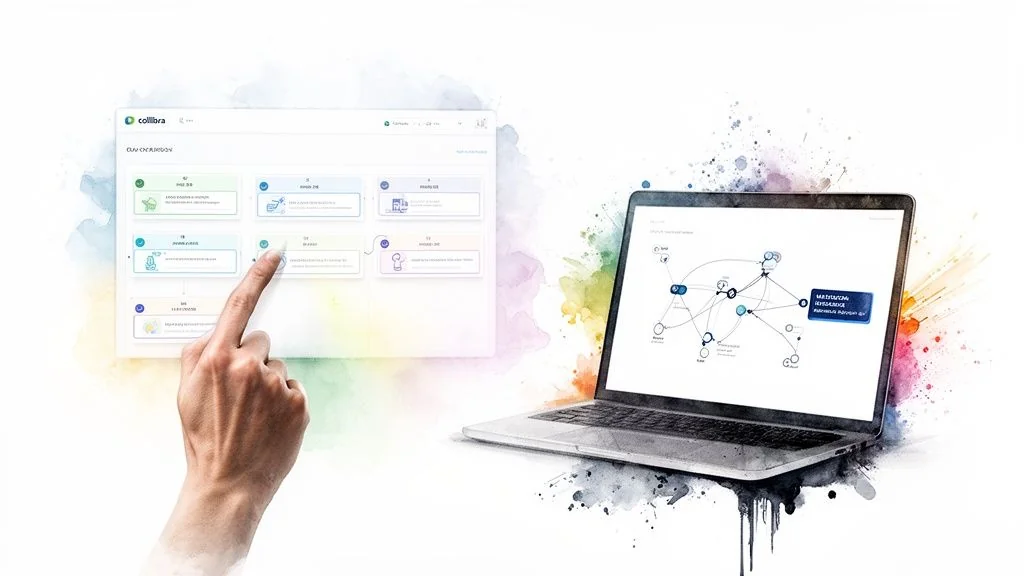
Collibra operationalizes governance through software rather than a paper framework. It embeds stewardship, policy enforcement, and metadata management directly into the workflows where data gets created and consumed, so governance becomes an active process instead of a static document.
Large enterprises running modern stacks use it at scale - tech companies apply it for data democratization on Snowflake and Databricks, and financial services firms use its automated lineage and workflow features to prove regulatory compliance for specific data elements.
Strategic Breakdown & Analysis
Collibra’s strength is turning abstract policy into automated action inside one platform, bridging the business side (defining rules and meaning) and IT (implementing them).
- When to use it: Organizations that already have governance principles defined - often DAMA-based - and need to operationalize them at scale on a modern cloud stack.
- Why it works: It replaces manual, email-driven governance with automated workflows for access requests and glossary updates, and pulls technical metadata straight from source systems.
Key Insight: Collibra is an operating model, not just a tool. Treating rollout as a business transformation - not a software deployment - is what determines whether it sticks.
How much does a Collibra rollout cost and take?
Target one or two high-value domains first - customer data or financial reporting - and prove ROI before expanding. Turn on native Snowflake and Databricks connectors from day one for automated lineage. Map governance workflows (report certification, data quality resolution) before configuring the platform. Budget 6-12 months for initial deployment; first-year cost for platform, services, and training typically runs $500K-$1.5M for enterprise projects.
8. Everest Group’s Data Governance Maturity Model
What is Everest Group’s Data Governance Maturity Model?
Everest Group’s model assesses organizational capability across five maturity levels rather than dictating implementation steps. Built from research across hundreds of organizations, it links maturity directly to outcomes like risk mitigation, operational efficiency, and business value.
Procurement teams and executives use it to evaluate data engineering consultancies or benchmark internal programs - a financial services firm might build a multi-year governance roadmap from it, while service providers align their offerings to its criteria to prove governance expertise to prospective clients.
Strategic Breakdown & Analysis
The model’s strength is its external, objective perspective. It shifts the conversation from technical implementation detail to measurable business impact, which resonates with executive audiences.
- When to use it: Procurement and vendor management teams running RFPs for data engineering services, or CIOs and CDOs benchmarking initiatives against peers.
- Why it works: It gives everyone a common, third-party language for capability, which makes vendor and internal-team comparisons closer to apples-to-apples.
Key Insight: Everest Group’s model is an assessment and benchmarking tool, not a how-to guide like DAMA-DMBOK. Its value is in asking the right questions and measuring what matters when evaluating external partners.
How do you use the Everest model with vendors?
Write RFP questions around Everest’s maturity levels and ask vendors to show how past projects hit Level 3 (Managed) or Level 4 (Optimized) outcomes. Use its benchmarking data in board presentations to justify the ROI of moving up a level. Pair it with DAMA-DMBOK - Everest supplies the “what” and “why,” DAMA supplies the “how” - and run the assessment annually alongside your strategic planning cycle.
8 Data Governance Frameworks Compared
| Framework | Implementation complexity | Resource requirements | Expected outcomes | Ideal use cases | Key advantages | Typical cost/time |
|---|---|---|---|---|---|---|
| DAMA-DMBOK (Data Management Body of Knowledge) | High - comprehensive, steep learning curve | Large cross-functional teams, metadata tools, training, governance council | Holistic data governance, improved data quality, clear roles and processes | Large enterprises, multi-platform modernization (Snowflake, Databricks) | Industry standard coverage across full data lifecycle; clear role definitions | $500K-$2M+; 12-24 months typical |
| COBIT (Control Objectives for IT) | High - control-focused and detailed | Audit/compliance teams, monitoring tools, governance processes, training | Strong controls, reduced audit findings, regulatory alignment | Regulated industries (banking, healthcare), vendor/procurement assessments | Strong risk/compliance emphasis and alignment with internal audit | Implementation services $300K-$1.5M; training $3K-$8K/person |
| FAIR (Findable, Accessible, Interoperable, Reusable) | Low-Medium - lightweight, principle-based | Metadata/catalog tools, automation, technical stewards, semantic layers | Improved discoverability, interoperability, faster analytics and reuse | Cloud-native analytics, AI/ML teams, Snowflake/Databricks migrations | Modern stack alignment enabling self-service and faster time-to-insight | Tooling $30K-$200K/yr; initial consulting $50K-$150K; months to realize benefits |
| NIST Data Governance Framework | Medium - principles-based and flexible | Internal resources, alignment with NIST cybersecurity, continuous monitoring | Improved security/compliance posture, continuous improvement cycles | Federal agencies, government contractors, critical infrastructure | Government-endorsed, aligns with NIST Cybersecurity Framework | $50K-$200K; iterative implementation with lower upfront cost |
| ISO/IEC 38505 (Corporate Governance of IT) | High - executive/board level engagement required | Executive sponsorship, auditing, consulting, policy documentation | Board-level accountability, cross-border governance alignment, stakeholder confidence | Multinationals, organizations seeking ISO certification and investor assurance | International standard facilitating multi-jurisdictional credibility | Certification $150K-$400K; implementation 18-36 months |
| Gartner Data Management & Analytics (DMA) | Low-Medium - assessment focused, proprietary | Gartner subscription/advisory, assessment services for validation | Maturity benchmarking, peer comparisons, prioritized investment roadmap | CIOs/CDOs, procurement, vendor evaluation and benchmarking | Empirical benchmarking and clear capability statements for decision-making | Subscription $15K-$100K; assessments $50K-$200K |
| Collibra Intelligent Data Governance Platform | Medium-High - platform deployment and change mgmt | Platform licenses, implementation services, integrations, training | Operationalized governance: lineage, metadata, automated workflows | Enterprises needing tool-driven governance on Snowflake/Databricks | Workflow automation, native cloud integrations, automated lineage | Licensing $150K-$500K+/yr; 6-12 month rollout; first-year $500K-$1.5M |
| Everest Group Data Governance Maturity Model | Low-Medium - outcomes-focused maturity assessment | Research subscription, assessment services, benchmarking data | Business-aligned governance roadmap, vendor capability benchmarking | Procurement teams, vendor assessments, ROI-driven governance programs | Outcomes and vendor benchmarking tailored to procurement needs | Subscriptions $10K-$50K; assessments $25K-$100K |
How do you combine these frameworks into one program?
Pick a structural anchor and layer in controls and roles, rather than adopting a single framework wholesale. A financial services firm might anchor in COBIT’s control objectives for auditability while borrowing DAMA’s knowledge areas for stewardship and quality. A research-driven biotech might prioritize FAIR for interoperability and layer in a lightweight NIST implementation for security.
Avoid the “big bang” rollout - it overwhelms stakeholders and stalls momentum. Pick one high-impact, low-complexity data domain as a pilot before expanding.
Strategic Insight: Make your first governance project a quick win tied to a live business initiative. If the company is launching an AI-powered recommendation engine, focus initial governance work on the customer data domain that feeds it - a measurable improvement in model accuracy or data prep time builds the case for the next phase.
What is a practical first-90-days roadmap?
- Run a maturity assessment. Before picking a framework, benchmark your current state - data quality, stewardship, policy enforcement, tooling - using a model from Gartner or Everest Group.
- Set business-centric objectives. Skip “implement a data catalog” and aim for “cut marketing analytics report generation by 30%.” That framing keeps governance tied to business value and executive sponsorship.
- Build a hybrid starter kit. Borrow structure (data domains, metadata management) from DAMA, controls (GDPR, CCPA) from COBIT or NIST, and a simple RACI matrix for Owners, Stewards, and Custodians on one domain.
- Pilot, measure, iterate. Launch in the chosen domain, track KPIs against the business objective, and use stakeholder feedback to refine the framework before expanding further.
A working governance program treats data as a strategic asset rather than a compliance cost - the framework choice matters less than whether the pilot ships and the roadmap gets funded past year one.
Ready to find an implementation partner? The vetted firm profiles on the Data Engineering Companies Index cover consultancies with real governance-framework experience on Snowflake and Databricks. For the operational playbook that pairs with framework selection, see data governance best practices and data governance strategies.
Researched & written by
Data-driven market researcher with 20+ years in market research and 10+ years helping software agencies and IT organizations make evidence-based decisions. Former market research analyst at Aviva Investors and Credit Suisse.
Previously: Aviva Investors · Credit Suisse · Brainhub · 100Signals
Vetted partners
Top Data Governance Partners
Vetted firms whose specialty matches this article.
More in Data Governance
Data Lakehouse vs Data Mesh: A 2026 Decision Guide
Choose the right architecture for your enterprise. A detailed comparison of data lakehouse vs data mesh on cost, governance, performance, and vendor selection.
Data Reliability Engineering A Guide for CTOs
Learn what Data Reliability Engineering (DRE) is, why it matters, and how to implement it. A complete guide for leaders evaluating data engineering partners.
Data Catalog Tools Comparison for Engineering Leaders
Data catalog tools comparison - For engineering leaders: This data catalog tools comparison provides a deep dive into Alation, Collibra, Atlan, & Informatica. S