10 Actionable Data governance Best Practices for 2026
Data governance best practices come down to five things working together: a framework with real executive backing, a catalog people actually use, clear ownership instead of finger-pointing, quality checks built into pipelines rather than bolted on after, and access controls that scale with self-service analytics. Skip any one of them and the rest becomes theater - policies nobody follows, a catalog nobody trusts, or an access model nobody can audit.
This guide covers ten practices for building a governance program on platforms like Snowflake and Databricks, plus a comparison table for weighing implementation complexity against expected outcomes. Governance turns out to be a harder capability to find than most data engineering work: only 11 of the 86 firms profiled in the Data Engineering Companies Index name it explicitly among their capabilities, which says more about how specialized the work is than how common the need is.
What this guide covers:
- Framework and ownership models that hold up against actual org charts, not just policy documents.
- Data quality and lineage practices that catch problems before they reach a dashboard.
- Access control design that protects sensitive data without locking out the people who need it.
- Continuous review practices that keep a governance program from going stale a year after launch.
1. Why does data governance start with an executive-sponsored framework?
A governance framework without executive sponsorship is a list of suggestions nobody is required to follow. Appoint a Chief Data Officer or a governance steering committee with the authority to enforce policy, then codify rules for data classification, retention, security, and regulatory compliance that map to actual business risk. Our data governance framework template walks through the four pillars, policies, roles, processes, and metrics, that most programs need to operationalize.
A global financial institution subject to SOX and GDPR would use its framework to map specific data elements to compliance controls, so financial reporting data carries clear access controls and audit trails while customer data handling aligns with consent requirements. Modern platforms like Snowflake and Databricks now build governance capabilities directly into their architectures, which lowers the technical lift but does not replace the need for a chartered owner of the policy itself.
Actionable Implementation Tips
- Secure executive sponsorship. Appoint a CDO or form a steering committee with C-level representation that meets quarterly at minimum to review progress and resolve escalations.
- Define and document policies. Start with classification, access control, and retention, mapped directly to regulatory requirements like HIPAA or CCPA rather than generic best-practice language.
- Launch a pilot, not a big-bang rollout. Select one business domain, such as customer data, to pilot the framework and refine the process before scaling it.
- Establish a central knowledge base. Use Confluence, SharePoint, or a similar tool to keep policies, standards, and procedures in one version-controlled place.
2. What makes a data catalog worth maintaining?
A data catalog only earns its keep if people actually use it to find, understand, and trust data instead of relying on tribal knowledge. Effective metadata management documents who owns each dataset, where it came from, how it’s defined, and how reliable it is, turning data discovery from a Slack-message hunt into a search query. That distinction matters for scoping the work: our explainer on data governance vs. data management draws the line between the policy layer and the platform-engineering layer that supports it.
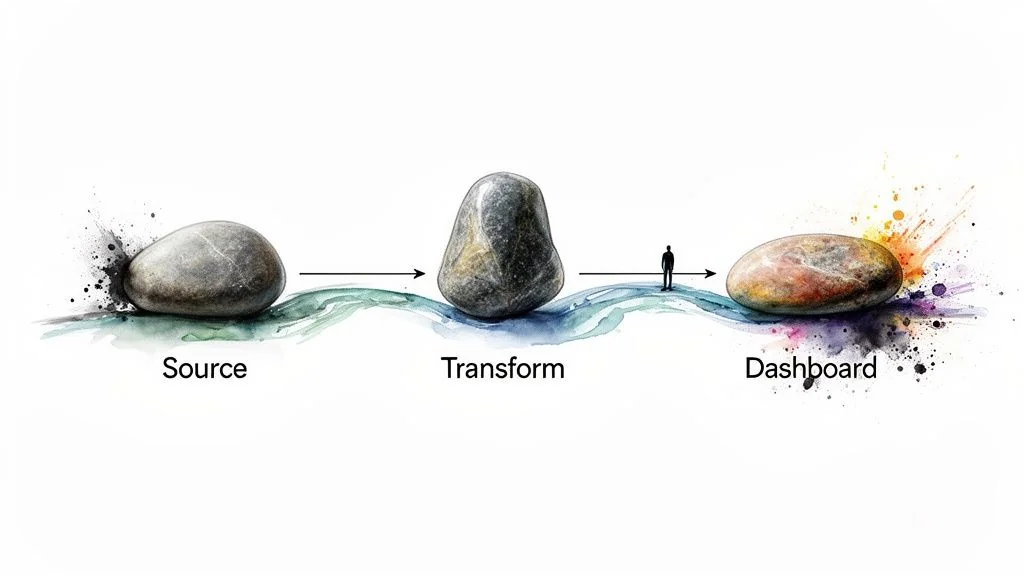
A retail company can use a catalog like Alation or Collibra to trace a “customer lifetime value” metric from its executive dashboard back to the raw transactional data, so everyone understands the calculation and trusts the number. Databricks’ Unity Catalog now captures lineage natively, and companies like Uber and Lyft built their own catalogs (Databook and Amundsen) years ago because discovery at scale doesn’t work without one. This is a cornerstone of any data governance strategy that intends to survive contact with real usage.
Actionable Implementation Tips
- Start with high-value datasets. Catalog the domains, customer, product, sales, that drive most of the business value instead of trying to document everything at once.
- Integrate with your data stack. Connect the catalog to your cloud platform (Snowflake, Databricks) and to dbt, which can populate column descriptions and lineage from its own metadata.
- Appoint data stewards. Assign business and technical stewards to specific domains and task them with curating definitions and certifying key assets.
- Build a business glossary. Define terms like “Active User” or “Gross Margin” with business leaders, then link those terms to the physical data assets so interpretation stays consistent.
3. Who should own data, and who should steward it?
Data Owners, usually business leaders, are accountable for a data domain’s strategic value and compliance; Data Stewards, usually subject matter experts, handle the day-to-day work of quality, metadata, and access. Without that split, “who is responsible for this data” has no answer when a report breaks, and accountability evaporates. Firms that specialize in this kind of program design show up under master data management consulting if you need outside help standing up the model.
A large retailer might designate the VP of Marketing as Data Owner for customer-level data, accountable for its compliant use in campaigns, while a Senior Marketing Analyst acts as Data Steward, defining what counts as a valid customer address and working with IT to enforce it. That split prevents the common failure mode where a data issue surfaces and every team points at another team.
Actionable Implementation Tips
- Document roles with a RACI matrix. Build one for key domains like Customer, Product, and Finance so owner versus steward responsibilities are explicit, not assumed.
- Start with critical domains. Prioritize high-value, high-risk data first rather than assigning owners to every dataset at once.
- Establish a steward community of practice. Give stewards a forum to standardize definitions, like a shared definition of “Active Customer,” and solve cross-functional problems together.
- Tie stewardship to performance reviews. Link stewardship activities to job descriptions so the role is a real professional responsibility, not a side project.
4. What does a data quality standard need to cover?
A data quality standard needs measurable thresholds, accuracy, completeness, consistency, and timeliness, enforced as automated tests inside the pipeline rather than caught manually after the fact. Rules should be version-controlled and documented like code, so issues get flagged at the source instead of surfacing three dashboards downstream.
A marketing team relying on customer contact data for segmentation might enforce a completeness threshold on the email_address field and validate its format with a regex check before records enter the marketing automation platform. dbt supports this kind of in-workflow testing, and dedicated tools like Soda and Great Expectations handle broader pipeline monitoring.
Actionable Implementation Tips
- Define quality dimensions and thresholds. Set explicit SLAs, for example a timeliness target for sales data ingestion or an accuracy threshold for product SKUs against a source system.
- Integrate checks into pipelines. Use dbt tests or similar tools to run validations on every model build and stop the pipeline when a critical threshold is breached.
- Automate monitoring and alerting. Deploy Great Expectations or Soda to profile data continuously and route warnings versus critical failures to the right escalation path.
- Build a feedback loop. Give data consumers a clear way, a Slack channel or a Jira queue, to report quality issues back to the data owner.
5. How should access control be designed for self-service analytics?
Role-Based Access Control (RBAC), and its more granular counterpart Attribute-Based Access Control (ABAC), should enforce the principle of least privilege: users get access to exactly the data their job requires, no more. Snowflake and Databricks both build this in natively now, with row-level security and dynamic column masking available as platform features rather than custom builds.
A healthcare system can use RBAC to grant doctors access to patient records within their department while a billing specialist sees only financial information. ABAC adds conditions on top, restricting access to a clinician’s active shift, for instance. This level of control is what regulations like HIPAA actually require in practice, not just in policy language.
Actionable Implementation Tips
- Design a clear role hierarchy. Map roles like Financial Analyst, Data Scientist, and Marketing Manager to specific data permissions, aligned with your identity provider groups in Okta or Azure AD.
- Start from zero access. Grant only the permissions a role actually needs rather than provisioning broadly and trimming later.
- Automate provisioning and deprovisioning. Tie your data platform to your identity provider so access updates automatically when someone joins, changes roles, or leaves.
- Run quarterly access reviews. Audit who has access to what on a schedule, and revoke permissions that no longer match the role.
6. Why does lineage matter beyond compliance audits?
Data lineage maps how data flows from source to destination, which means a change to a source-system column doesn’t silently break a dozen downstream dashboards. Impact analysis, powered by lineage, tells you the blast radius of a proposed change before you make it, which is a maintenance requirement, not just an audit checkbox.
dbt now captures lineage automatically by parsing SQL to build dependency graphs, and platforms like Collibra and Alation extend that to cross-system, column-level lineage that connects technical metadata to business context. That level of detail is what lets a team trace a KPI on a C-level dashboard back to the raw source tables when something looks wrong. Our comparison of data lineage tools breaks down which platforms handle which depth of tracking.
Actionable Implementation Tips
- Automate lineage capture. Use native features in dbt (
dbt docs generate) or Databricks Delta Live Tables, and integrate open standards like OpenLineage to pull metadata from orchestrators like Airflow and Prefect. - Establish naming conventions. Consistent naming for tables, columns, and schemas makes automated tracing far more reliable.
- Track column-level lineage for sensitive data. For PII specifically, column-level tracking supports precise impact analysis for privacy audits.
- Wire impact analysis into CI/CD. Run an automated impact report before deploying pipeline changes, and require sign-off from downstream owners when the impact score crosses a threshold.
7. How do data contracts keep a data mesh from turning into chaos?
Data contracts are machine-readable agreements between data producers and consumers that define a data product’s schema, quality, and service levels, and they’re what makes a decentralized data mesh architecture workable instead of a source of constant breakage. Contracts get validated automatically in CI/CD, which turns governance from a manual after-the-fact cleanup into an automated, proactive check. Our piece on data contracts in data engineering covers the mechanics in more depth.
A marketing team consuming customer data from a sales domain can rely on a contract guaranteeing the customer_id field is always present and correctly formatted. If the sales team tries to deploy a change that breaks that guarantee, the CI/CD pipeline fails the build before it reaches production. dbt now ships contract features, and Confluent Schema Registry enforces schema evolution for streaming data.
Actionable Implementation Tips
- Start with critical data products. Define contracts first for high-value datasets that have multiple downstream consumers.
- Automate contract validation in CI/CD. Use dbt contracts or a schema registry to check schema, data types, and quality rules before code merges.
- Establish a contract review process. New contracts, and changes to existing ones, should get sign-off from both producer and consumer teams before deployment.
- Define a deprecation policy. Versioning, a notification period, and migration support for consumers should be standard, not improvised.
- Monitor for violations. Alert data product owners immediately when a contract is breached in production.
8. Why do governance programs need a community, not just a policy doc?
Policies that nobody understands or champions don’t get followed, no matter how well they’re written. A data steward council creates a feedback loop between the central governance team and the business units doing the actual work, and it’s where stewards trade solutions instead of each team reinventing the same fix.
A large retailer might run a Product Data Steward Council that meets monthly, with stewards from merchandising, marketing, and supply chain standardizing product attributes and resolving the discrepancies that cause downstream reporting errors. That peer-to-peer problem-solving tends to work better than a central team dictating standards from a distance. Snowflake and Microsoft both offer training and certifications now, on the reasonable assumption that trained users adopt governance faster than untrained ones.
Actionable Implementation Tips
- Establish a data steward council. A cross-functional group that meets at least monthly, focused first on sharing challenges and standardizing definitions.
- Build role-specific training. Tailor modules for owners, stewards, and consumers, using platforms like Coursera or LinkedIn Learning for the basics and internal training for your specific tools and policies.
- Launch a governance knowledge hub. A wiki or intranet page holding glossaries, policy documents, process maps, and steward contacts in one place.
- Host quarterly governance forums. Include executive participation to share wins, give roadmap updates, and recognize steward contributions publicly.
9. Which tools actually belong in a governance stack?
A governance stack needs a catalog, a quality tool, a lineage layer, and an access control system that integrate with each other and with your core data platform, not a pile of disconnected point solutions. Integration is the differentiator: a catalog like Atlan or Alation connected to dbt and to an identity layer like Okta produces automated governance instead of manual, error-prone enforcement.
A retail company could use this kind of integrated stack to automatically tag PII as it enters Snowflake, have the catalog classify it, have Great Expectations validate its format, and have access policies apply automatically based on roles defined in the identity system. That’s what “automated” governance actually looks like in practice, not a marketing claim.
Actionable Implementation Tips
- Evaluate tools on integration, not features. Prioritize native connectors and API support for your existing platforms (Snowflake, Databricks) and identity systems.
- Start with a core set. Three to five essential tools covering cataloging, quality, and access management beats a dozen specialized point solutions rolled out at once.
- Prioritize automation. Pick tools that automate classification, lineage mapping, and policy enforcement, for example using Databricks Unity Catalog for fine-grained access control natively.
- Assign tool ownership. Someone specific should own each tool’s configuration, maintenance, and training, or the investment erodes over time.
10. Does governance work end once the framework ships?
No. Governance is a continuous program, not a one-time project, and it needs regular effectiveness reviews to stay relevant as data sources, regulations, and business priorities change. Treating the initial framework as the finish line is how programs quietly go stale.
A healthcare organization can track a governance dashboard showing the percentage of patient records compliant with HIPAA standards or the average time to resolve a data quality issue, and watch those metrics move as evidence the program is working. Maturity models from firms like Gartner give organizations a structured way to benchmark where they stand and plan the next stage.
Actionable Implementation Tips
- Define 5-10 core KPIs. Data quality scores, policy compliance rates, issue resolution times, and the number of certified assets are a reasonable starting set.
- Build a governance dashboard. Visualize KPIs in a BI tool and make it visible to executives and stewards, not just the governance team.
- Hold quarterly reviews. Bring the steering committee together to review trends, address roadblocks, and adjust priorities.
- Run annual maturity assessments. Use a framework like Gartner’s or CMMI to benchmark the program and update the roadmap.
- Collect user feedback systematically. Annual surveys and focus groups with data consumers surface what isn’t working before it becomes a bigger problem.
Top 10 Data Governance Best Practices Comparison
| Item | Implementation Complexity | Resource Requirements | Expected Outcomes | Ideal Use Cases | Key Advantages |
|---|---|---|---|---|---|
| Establish a Data Governance Framework, Executive Sponsorship, and Policies | High - organization-wide change, policy design | Executive sponsorship, CDO/lead, legal/compliance, long-term budget | Clear accountability, consistent policies, regulatory compliance | Regulated industries, large platform migrations | Central authority, reduced legal/reputational risk, audit readiness |
| Implement Data Cataloging and Metadata Management | Medium - integrations and ongoing curation | Catalog tool, metadata automation, data stewards | Improved discovery, documented lineage and definitions | Mid/enterprise analytics teams, migrations with inherited assets | Faster data discovery, impact analysis, better trust |
| Define Data Ownership and Stewardship Models | Medium - role definition and cultural change | Role assignments, training, RACI matrices | Clear ownership, improved data quality and SLAs | Data mesh adoption, scaling governance across domains | Domain alignment, faster decisions, accountability |
| Establish Data Quality Standards and Monitoring | Medium-High - rule definition and pipeline integration | Quality tools, tests in pipelines, monitoring and remediation workflows | Reliable analytics, fewer downstream errors, SLAs met | AI/ML production, critical reporting and regulatory data | Prevents bad data, early detection, reduces remediation cost |
| Implement Role-Based Access Control (RBAC) and Data Security | High - fine-grained controls and IAM integration | IAM, access controls, audit logging, security ops | Reduced unauthorized access, compliance, audit trails | Regulated enterprises, multi-tenant or sensitive data environments | Strong access enforcement, auditability, least-privilege control |
| Create Data Lineage and Impact Analysis Capabilities | Medium - automated capture and visualization | Lineage tools, instrumented pipelines, visualization dashboards | Faster root-cause analysis, clear change impact | Large/complex pipelines, migrations, compliance audits | Traceability of data flows, reduced change risk |
| Implement Data Contracts and Data Mesh Architecture | High - CI/CD, schema governance, cultural shift | Schema registries, CI pipelines, developer discipline | Stable producer-consumer interfaces, decentralized delivery | Organizations scaling domains, streaming platforms | Prevents breaking changes, enables autonomous domains |
| Build Data Governance Communities and Training Programs | Low-Medium - coordination and curriculum development | Training materials, facilitators, time from participants | Increased data literacy, adoption, sustained governance | Cultural transformation, post-migration enablement | Peer learning, faster adoption, broader ownership |
| Establish Data Governance Technology Stack and Tool Integration | High - tool selection and cross-platform integration | Tool licenses, engineers for integration, ongoing maintenance | Automated enforcement, centralized visibility, fewer manual tasks | Enterprise governance, heterogeneous tool environments | Automation, consolidated governance view, simplified audits |
| Implement Continuous Governance and Regular Effectiveness Reviews | Medium - programmatic monitoring and iteration | Metrics, dashboards, periodic reviews, executive oversight | Measured governance ROI, continuous improvement, relevance maintained | Mature governance programs, regulated organizations | Sustained governance value, data-driven prioritization and improvements |
Putting the Framework Into Practice
These ten practices work as a system, not a checklist to complete in order. The framework sets accountability; the catalog and lineage make data findable and traceable; quality standards and access control keep it trustworthy and secure; contracts and tooling automate the enforcement; and community and continuous review keep the whole thing from decaying once the initial project team moves on.
Avoid a big-bang rollout. In the first 90 days, secure an executive sponsor, draft a minimum viable policy set covering classification, access, and quality, and appoint stewards for one pilot domain. Over the next two quarters, stand up a data catalog for that domain and establish quality baselines you can actually measure. After that, expand domain by domain, formalize training, and integrate the catalog, quality, and security tools so enforcement stops depending on manual effort.
If you’re still deciding how governance fits alongside a platform move, data migration best practices covers the sequencing question directly. For finding a partner who can help build the program itself, our directories for enterprise data engineering, healthcare data engineering, and fintech data engineering firms narrow the search by the regulatory context you’re working under.
Researched & written by
Data-driven market researcher with 20+ years in market research and 10+ years helping software agencies and IT organizations make evidence-based decisions. Former market research analyst at Aviva Investors and Credit Suisse.
Previously: Aviva Investors · Credit Suisse · Brainhub · 100Signals
Vetted partners
Top Data Governance Partners
Vetted firms whose specialty matches this article.
More in Data Governance
Practical Data Governance Strategies for the Modern Data Stack
Discover data governance strategies you can implement in cloud environments with practical KPIs, frameworks, and real-world value.
Data Lakehouse vs Data Mesh: A 2026 Decision Guide
Choose the right architecture for your enterprise. A detailed comparison of data lakehouse vs data mesh on cost, governance, performance, and vendor selection.
Data Reliability Engineering A Guide for CTOs
Learn what Data Reliability Engineering (DRE) is, why it matters, and how to implement it. A complete guide for leaders evaluating data engineering partners.