Parquet vs Avro: A Technical Guide to Big Data Formats
Parquet is a columnar storage format built for fast analytical reads. Avro is a row-based format built for fast writes and flexible schema evolution. Choose Parquet for read-heavy analytics (data warehouses, lakehouses, BI dashboards); choose Avro for write-heavy ingestion (event streams, Kafka topics, schemas that change often).
Parquet vs Avro Key Differentiators
| Criterion | Apache Parquet | Apache Avro |
|---|---|---|
| Storage Layout | Columnar (column-oriented) | Row-based (row-oriented) |
| Primary Use Case | Analytical queries, BI, data warehousing | Data serialization, event streaming (Kafka) |
| Query Performance | Excellent for analytical queries (reads a subset of columns) | Fair; slower for analytics as it must read entire rows |
| Write Performance | Slower due to columnar organization and sorting | Excellent due to simple append-only writes |
| Compression | Superior; groups similar data types for high compression ratios | Good; compresses entire rows, less effective than columnar |
| Schema Evolution | Supported but more rigid (schema is in the file footer) | Highly flexible; schema is part of the file, enabling easy evolution |
Technical Recommendation: Use Parquet for analytical data stores like a data warehouse or data lakehouse, where query performance is the primary concern. Use Avro for the data ingestion layer, particularly in streaming architectures where write throughput and schema flexibility are critical.
Parquet’s columnar layout lets query engines like Apache Spark, Snowflake, and Databricks read only the columns a query touches, skipping the rest. Avro’s row-based layout serializes a whole record at once, which is efficient for capturing event streams from sources like Apache Kafka and keeps the schema tightly coupled to the data, so schema changes don’t break existing consumers. The rest of this guide walks through why each design produces those tradeoffs, with benchmark numbers and a decision matrix at the end.
How does storage architecture affect performance?
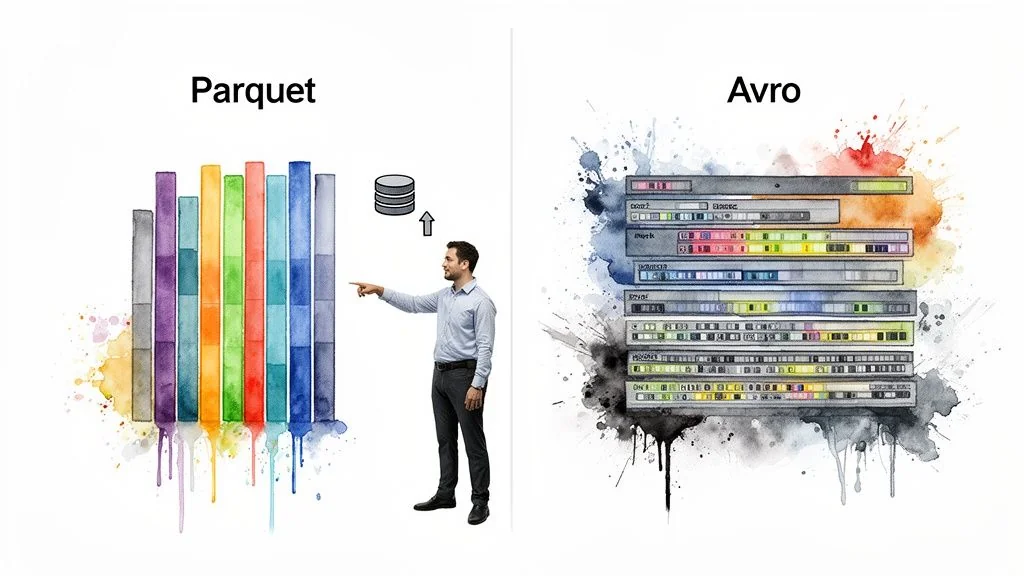
The physical layout on disk is the single difference that drives everything else: query speed, write speed, compression, and schema flexibility. Parquet groups values by column; Avro groups values by row. Everything downstream follows from that choice.
How does Parquet’s columnar layout work?
Parquet groups all the values from a single column together instead of writing out full rows. For a customer table, all customer_id values sit in one block, all email_address values in another, and so on.
This layout suits analytical (OLAP) queries. When an engine runs SELECT AVG(order_value) FROM sales, it reads the order_value column directly and skips the bytes on disk holding customer_id, product_name, and every other unused column - cutting I/O sharply.
This is called projection pushdown, and it’s why Parquet is the default format for data warehouses and lakehouse platforms. Of the 86 firms profiled in the Data Engineering Companies Index, 66 list Snowflake and 64 list Databricks - the lakehouse platforms where columnar formats like Parquet are the default. Our guide on Databricks Delta Lake explains how that platform builds on Parquet’s strengths.
Consider this simple customer dataset:
Customer Data Example
| Customer ID | City | |
|---|---|---|
| 101 | test1@email.com | New York |
| 102 | test2@email.com | London |
| 103 | test3@email.com | Tokyo |
Parquet stores this data with each column’s values grouped together:
- Customer ID Block:
[101, 102, 103] - Email Block:
["test1@email.com", "test2@email.com", "test3@email.com"] - City Block:
["New York", "London", "Tokyo"]
How does Avro’s row-based layout work?
Avro serializes and stores an entire record - all its fields - as one continuous block of data. Using the same customer example, Avro writes each complete row in sequence.
This suits write-heavy systems that process whole records at once, such as event streaming with Apache Kafka, where producers continuously emit new, complete events. Avro just appends the next serialized record to the file - a low-overhead operation.
For Avro, the physical layout looks like:
[101, "test1@email.com", "New York"][102, "test2@email.com", "London"][103, "test3@email.com", "Tokyo"]
That structure makes writes fast but creates a bottleneck for analytics. To calculate the average order_value from an Avro file, a query engine has to read and deserialize every row - including columns it doesn’t need - just to reach the one field it wants. That’s why Avro runs substantially slower than Parquet on most analytical workloads.
How much faster is Parquet than Avro for queries?
Independent Athena benchmarks show Parquet queries running roughly 2-6x faster than the same queries against Avro, with the largest gaps on selective queries that touch only a handful of columns out of many. The mechanism is projection and predicate pushdown, both unavailable to a row-based format.

Query engines like Spark, Snowflake, and Databricks are built to exploit this gap.
What is projection pushdown?
Projection pushdown is the mechanism behind Parquet’s query speed: because data is stored in columns, the engine reads only the columns a query needs. For a table with 200 columns where an analysis needs three, the engine reads just those three from disk and ignores the other 197.
An Avro-based query, by contrast, forces the engine to process every byte of every row to extract the same three columns. Reading less data means faster, cheaper queries. Our comparison of Snowflake vs Databricks covers how those platforms are built around columnar formats.
What is predicate pushdown?
Predicate pushdown is how Parquet skips rows that can’t match a filter. Parquet files are organized into blocks called row groups, and each row group stores metadata - including the min/max values for each column in that block.
When a query includes a filter like WHERE order_date > '2025-11-01', the engine checks that metadata first. If a row group’s date range doesn’t overlap the filter, the engine skips the whole block without reading it.
Key Insight: Projection pushdown narrows the columns read; predicate pushdown narrows the rows read. Avro, being row-based, supports neither.
What do real benchmarks show?
In an independent Athena benchmark run by Chariot Solutions on a dataset of roughly 60 million clickstream events, Avro took 7.46 seconds to run a query while scanning 7.51 GB of data; Parquet completed the same query in 3.86 seconds while scanning 5.39 GB.1 Other queries in the same test showed even wider gaps - Parquet finished one query in 0.85 seconds against Avro’s 4.81 seconds.
This kind of performance difference shows up directly in cloud bills, since most platforms charge for compute time or data scanned:
- Lower compute costs: shorter query execution times reduce virtual warehouse or cluster bills.
- Reduced I/O charges: fewer read operations from cloud storage like Amazon S3 or Google Cloud Storage mean lower API costs.
- Faster time-to-insight: analysts and data scientists get results sooner.
Does Parquet compress better than Avro?
Yes. Parquet’s columnar layout almost always produces a smaller file than the same data stored in Avro, because compression algorithms work better against long runs of similar values than against mixed-type rows.

How columnar layout maximizes compression
Compression algorithms like Snappy and Gzip shrink files by finding repeating patterns and replacing them with small references. The more uniform the data, the more patterns they find, and the higher the compression ratio.
Parquet’s columnar layout groups all values from one column together - every user_country value, every event_timestamp - creating long, homogenous blocks that compress well.
Avro’s row-based structure stores each record as a mix of data types: an integer ID, a string email, a timestamp, maybe a boolean flag. That heterogeneity within each row makes it harder for compression algorithms to find repeating patterns, so Avro files end up larger.
How much storage does Parquet save in practice?
In the same Chariot Solutions benchmark, a dataset of 59.7 million events took 4.2 GB as Parquet versus 6.7 GB as Avro - a 37% reduction. A second run with 18.5 million events showed 1.3 GB for Parquet versus 2.1 GB for Avro, a 38% reduction.1 Smaller files also mean less data moved over the network and less data for a query engine to read off disk, compounding the query-speed advantage above.
What does a compression difference like this mean in dollars?
A 35-40% storage reduction adds up at petabyte scale. Here’s an illustrative scenario, not a specific vendor quote:
Scenario: A 1 Petabyte (PB) Data Lake
Assumptions:
- Total Data Size: 1 PB (1,000 TB)
- Cloud Storage Cost: $23 per TB/month (illustrative - check current pricing with your cloud provider)
- Parquet Storage Savings: a conservative 35% advantage over Avro, in line with the benchmark above
| Format | Storage Required | Monthly Cost | Annual Cost |
|---|---|---|---|
| Avro | 1,000 TB | $23,000 | $276,000 |
| Parquet | 650 TB | $14,950 | $179,400 |
| Annual Savings | $96,600 |
At this illustrative rate, switching to Parquet saves close to $100,000 a year per petabyte managed, and the savings scale with data volume. Understanding the difference between a data warehouse and a data lake matters here too, since where you store the data affects both cost and performance.
When does Avro outperform Parquet?
Avro wins on write throughput and schema flexibility - the two things that matter most for capturing data as it’s generated, like real-time event streaming. For systems where the primary job is ingestion, not analysis, Avro is usually the better default.
Why is Avro faster for writes?
Avro’s row-based layout serializes an entire record and appends it to the end of the file - a simple, low-overhead operation that maximizes throughput.
Parquet has to do more work to write: it buffers incoming records, sorts them by column, and writes them into organized row groups. That buffering and sorting consumes CPU and memory and adds latency that can bottleneck real-time ingestion.
The Bottom Line: Avro writes are simple appends. Parquet writes require buffering and sorting to build columnar blocks. That’s the core tradeoff for any write-heavy workload.
This is why Avro is the standard serialization format for Apache Kafka: capturing every message with minimal delay matters most in event-driven architectures, and Avro’s write efficiency matches Kafka’s throughput requirements.
How does Avro handle schema evolution?
Avro embeds the writer’s schema with the data, so a consumer can use its own (“reader’s”) schema to interpret it, keeping different versions compatible. That system supports three compatibility modes:
- Backward Compatibility: data written with a new schema can still be read by an older schema, as long as new fields have default values.
- Forward Compatibility: data written with an old schema can be read by a newer schema, since the new reader can ignore fields that no longer exist.
- Full Compatibility: both directions work, so producers and consumers on different versions can exchange data without coordination.
This flexibility keeps pipelines from breaking when a microservice adds a new field to an event. Parquet supports schema evolution too, but less flexibly - its schema lives in the file footer, and changes like reordering columns or altering nested types are harder to manage. For systems handling continuous streams from Kafka pipelines, event logs, or sensor data, that’s a meaningful operational difference. Confluent’s writeup on Avro and Kafka goes deeper on how the schema registry fits in.
Which format fits your use case?
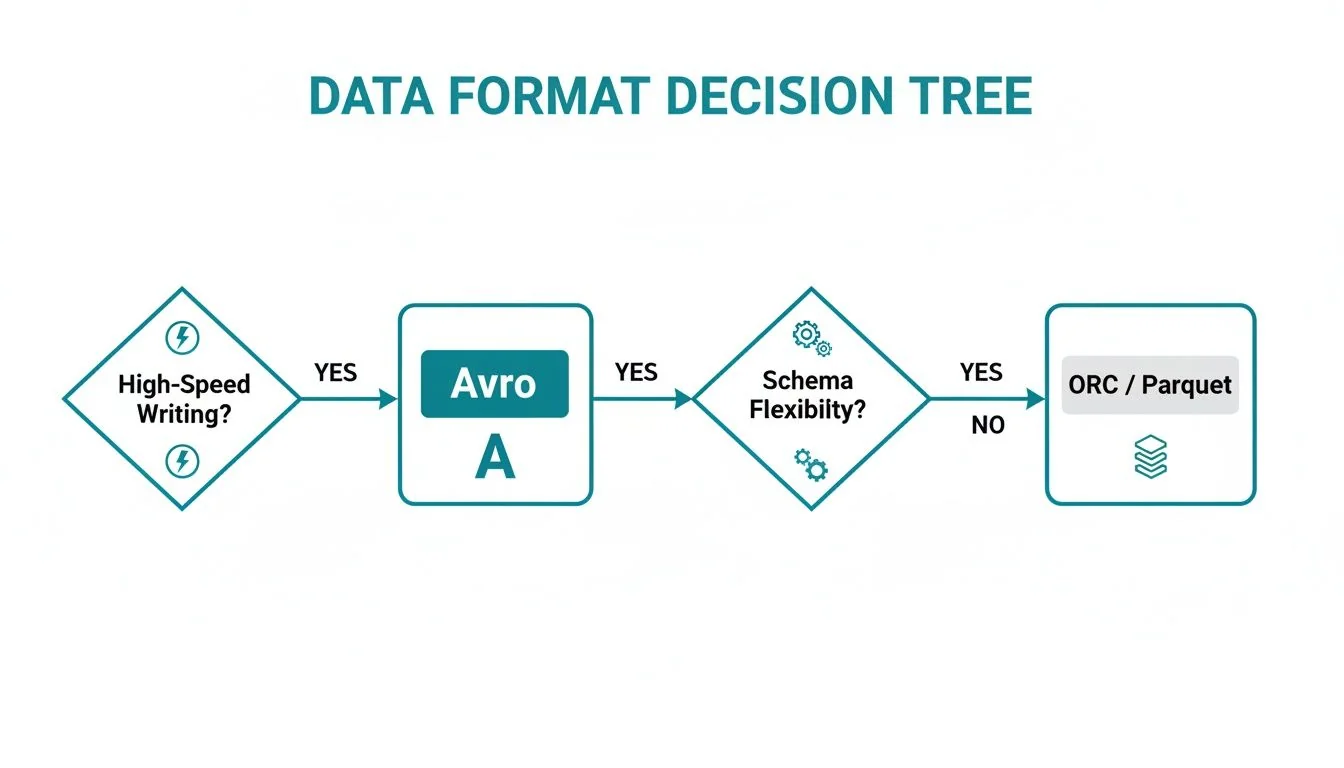
The decision comes down to one question: is the pipeline’s primary job reading data or writing it? Getting this wrong shows up as either slow, expensive queries (wrong choice: Avro for analytics) or ingestion bottlenecks and brittle pipelines (wrong choice: Parquet for streaming writes).
This video breaks down the core tradeoffs in practical terms.
When should you use Parquet?
For analytical queries, BI, or ad-hoc data exploration, Parquet is the clear choice. Its columnar layout matches the read-heavy patterns of platforms like Snowflake and Databricks.
Use Parquet when:
- Powering BI dashboards: tools like Tableau or Power BI benefit from fast column scanning and stay responsive.
- Running ad-hoc analytical queries: analysts and data scientists get shorter query times.
- Building a data lakehouse: high compression and efficient column access keep both storage and compute costs down.
When should you use Avro?
For real-time data capture and pipeline resilience, Avro is the standard choice. Its row-based structure is built for fast writes and flexible schema management.
Choose Avro for:
- Real-time event streaming with Kafka: Avro is the default serialization format for Apache Kafka messages, thanks to low write latency and schema registry support.
- A raw data landing zone: schema evolution lets ingestion pipelines absorb changes from diverse sources without failing.
- Inter-service communication: in a microservices architecture, Avro gives producers and consumers a data contract they can evolve independently.
Decision Matrix For Data Formats
| Use Case | Recommended Format | Key Rationale |
|---|---|---|
| BI & Interactive Analytics | Parquet | Columnar reads are extremely fast for the selective queries that power dashboards. |
| Real-Time Event Ingestion | Avro | Optimized for high-throughput writes and flexible schema evolution, ideal for Kafka streams. |
| Data Science & ML Features | Parquet | Efficiently reads only the specific columns (features) required for model training and inference. |
| Raw Data Lake Staging Zone | Avro | Handles evolving schemas from diverse sources without breaking ingestion pipelines. |
| Archival & Cold Storage | Parquet | Achieves the highest compression ratios, significantly reducing long-term storage costs. |
| ETL/ELT Intermediate Steps | Avro or Parquet | Depends on the step. Avro is better for row-level transformations; Parquet excels at aggregations. |
Can you use both Parquet and Avro together?
Yes - most production pipelines do. A common multi-stage architecture uses Avro at the ingestion edge, where write speed and schema flexibility matter most, and converts to Parquet before analytics, where read speed matters most.
Key Insight: A single format is rarely enough for an end-to-end pipeline. Using each format where its strengths apply is standard practice, not a compromise.
That architecture typically looks like:
- Ingestion (Avro): raw event data lands from Kafka into a staging area of the data lake as Avro files, prioritizing write speed and schema flexibility at the entry point.
- Transformation and storage (Parquet): a batch or micro-batch job, often using Apache Spark, reads the raw Avro data, cleans and transforms it, and rewrites it into a partitioned Parquet structure.
- Analytics (Parquet): downstream consumers - queries, BI tools, ML models - read the optimized Parquet data and get fast, high-performance columnar reads.
This Avro-to-Parquet pipeline gets the benefit of both formats: resilient, high-throughput ingestion and fast, cost-effective analytics.
Frequently Asked Questions
Can I use Parquet with Kafka?
It’s technically possible but an anti-pattern. Kafka is built for streaming a high volume of events with minimal delay, and Avro’s simple, row-by-row serialization matches that job better than Parquet, which needs to buffer and sort data before writing.
Writing Parquet directly from a Kafka stream adds latency that undermines the point of using Kafka.
The Field-Tested Approach: Use Avro for Kafka topics - it’s fast for writes and integrates well with schema registries. Land raw Avro events in a staging zone (S3 or ADLS), then use a batch or micro-batch job to convert to Parquet for analytics.
Which format do Databricks and Snowflake prefer?
Both Databricks and Snowflake are built around Parquet. Their query engines are designed to exploit its columnar structure for predicate pushdown (reading only necessary rows) and projection pushdown (reading only necessary columns).
If they had to process Avro instead, their engines would need to read every row start to finish, degrading performance and raising compute costs. For analytics in any modern lakehouse or data warehouse, Parquet is the native format.
How different is schema evolution in practice?
Substantial, and it directly affects pipeline resilience. Avro embeds the writer’s schema with the data, so downstream consumers can handle new, missing, or renamed fields without failing - useful when ingesting raw data from multiple, uncontrolled sources.
Parquet’s schema evolution is stricter: it handles new columns fine, but more complex changes are harder to manage. That makes Parquet better suited to final, curated datasets that have already been cleaned and structured for analysis - flexibility for ingestion, structure for analytics.
Format choice is one piece of a larger pipeline design. See how a data warehouse compares to a data lake for where processed Parquet data typically lands, check our ETL tools comparison for the ingestion tools that write Avro into a landing zone, and read the modern data stack overview for how both formats fit into a full pipeline.
Footnotes
-
Keith Gregory, “Athena Performance Comparison: Avro, JSON, and Parquet,” Chariot Solutions, 2023. https://chariotsolutions.com/blog/post/athena-performance-comparison/ ↩ ↩2
Researched & written by
Data-driven market researcher with 20+ years in market research and 10+ years helping software agencies and IT organizations make evidence-based decisions. Former market research analyst at Aviva Investors and Credit Suisse.
Previously: Aviva Investors · Credit Suisse · Brainhub · 100Signals
Vetted partners
Top Data Pipeline Partners
Vetted firms whose specialty matches this article.
More in Data Pipeline Architecture
A Leader's Guide to Apache Spark Optimization: Moving Beyond Quick Fixes
A practical framework for Apache Spark optimization: diagnosing the real bottleneck, tuning shuffle partitions and executor sizing, and choosing code fixes that cut runtime and cloud cost.

What Is Lakehouse Architecture? A Practical Guide
Discover what is lakehouse architecture and how it merges data lakes and warehouses to power modern AI and analytics. An expert guide to the essentials.

Data Warehouse vs. Data Lake: A Practical Decision Guide
Choosing between a data warehouse vs data lake? This guide cuts through the noise with practical comparisons of architecture, cost, and real-world use cases.