Fivetran vs Airbyte: An Enterprise TCO Analysis for 2026
Fivetran and Airbyte both move data from source systems into a warehouse, but they sell opposite operating models. Fivetran is a managed service: you pay a vendor to own uptime, connector maintenance, and schema handling. Airbyte is a more open platform: the entry price is lower, but more of that operational work shifts onto your own team, especially if you self-host. The real decision in fivetran vs airbyte isn’t which tool is cheaper on a pricing page - it’s whether you want to buy operational certainty or build it yourself.
Ingestion tooling choices like this one show up constantly in data engineering work: 78 of the 86 firms profiled in the Data Engineering Companies Index list data migration among their capabilities, and the ELT tool you pick here determines how much of that ongoing pipeline work your own team ends up owning versus handing to a vendor or an implementation partner.
This is fundamentally a data pipeline architecture decision. It shapes your ingestion operating model across Snowflake, Databricks, BigQuery, dbt, and orchestrators such as Airflow. Pick the wrong tool and you don’t just overpay - you lock your data team into the wrong kind of work for years.
Why isn’t the Fivetran vs Airbyte decision just about price?
Airbyte usually wins the procurement screenshot: its cloud pricing starts lower and the open-source edition is free to run. That comparison is incomplete to the point of being misleading, because it ignores who absorbs the work of keeping pipelines running when source APIs change.
A principal architect looks at total cost of ownership, not the subscription page. Fivetran’s list pricing is usage-based, billed per monthly active row, with a free tier up to 500,000 MAR and cost scaling from there as volume grows (Fivetran pricing). Airbyte’s plans run on volume-based or compute-based tiers, also starting free (Airbyte pricing). Neither list price tells you what the platform costs to operate.
That first-pass view breaks down in production.
What CTOs actually buy
You’re not buying sync jobs. You’re buying four things:
- Operational certainty. Will core pipelines keep running when source APIs change?
- Team focus. Will data engineers spend time on modeling and platform adoption, or on connector maintenance?
- Risk posture. Who owns uptime, support, and incident resolution?
- Scalability path. Does the platform get easier or harder to operate as the estate grows?
Practical rule: If your team’s competitive advantage isn’t building and operating ingestion infrastructure, treat “flexibility” as a cost center unless it directly gives you access to a source you can’t otherwise reach.
The hidden asymmetry
Fivetran sells a managed service. Airbyte sells optionality.
That sounds abstract, but the consequences are concrete. Fivetran’s model is opinionated and narrower. Airbyte’s model is extensible and broader. The trade-off is that one pushes complexity onto the vendor, while the other gives your team the ability, and the burden, to absorb that complexity.
For enterprises, that burden compounds in second-order ways:
- Security review gets harder when you self-host and own more of the runtime.
- Staff planning gets harder when Kubernetes and connector debugging become part of the data platform remit.
- Roadmaps slip when warehouse migration teams get pulled into ingestion incidents.
- Data governance programs stall when engineers spend cycles stabilizing extractors instead of defining controls in dbt, catalogs, and access policies.
If you frame fivetran vs airbyte as a line-item software comparison, Airbyte often looks attractive. If you frame it as an operating model choice, the decision changes fast.
What’s the real difference in philosophy between Fivetran and Airbyte?
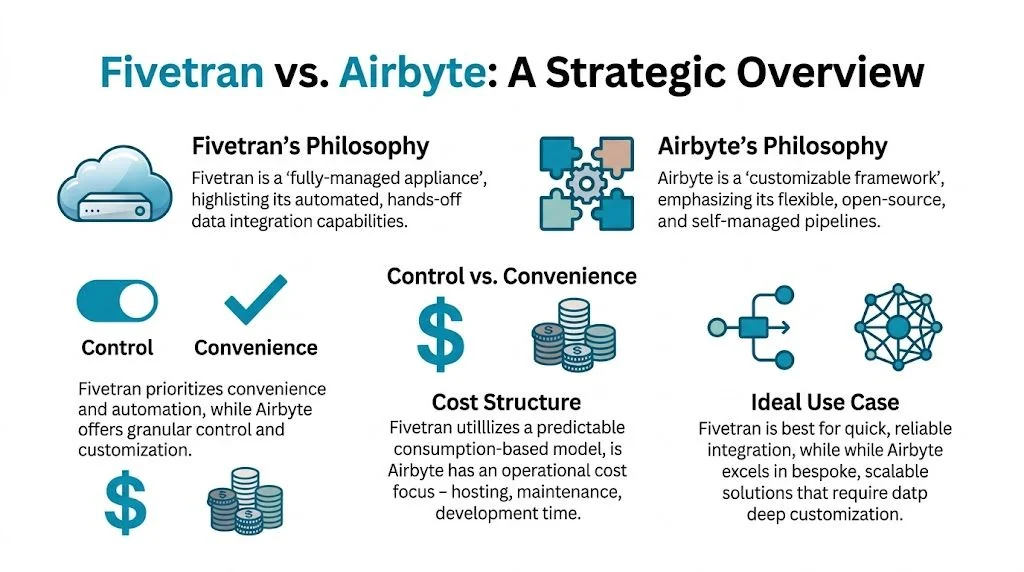
The divide isn’t managed versus open source in the abstract. It’s whether you want ingestion to be a software purchase your team consumes, or an internal operating function your team runs.
Side by side for executives
| Dimension | Fivetran | Airbyte |
|---|---|---|
| Core philosophy | Managed ELT service with vendor-owned operations | Open-source and cloud ELT platform with more customer-owned decisions |
| Best fit | Enterprises optimizing for predictable delivery and lower platform labor | Technical teams willing to trade labor for flexibility and connector coverage |
| Connector posture | Curated, vendor-maintained catalog | Broad catalog with stronger long-tail and custom connector options |
| Cost pattern | Higher visible software spend, lower internal maintenance burden | Lower entry price, but operating cost can rise with support, hosting, and engineering time |
| Leadership question | Do we want to buy reliability as a service? | Do we want to build ingestion capability as part of the platform team? |
The strategic choice is easy to describe and easy to underestimate. Fivetran concentrates responsibility with the vendor. Airbyte distributes more of that responsibility back to your team, especially if you self-host or depend on custom connectors. The first-order difference is control. The second-order difference is who absorbs outages, schema drift, API changes, and connector regressions.
That second-order effect matters more than the headline price.
The strategic split
Fivetran fits organizations that treat data ingestion as plumbing. The goal is to keep source systems flowing into the warehouse with minimal debate, minimal customization, and clear accountability when something breaks. That usually maps well to larger companies with strict delivery commitments, thin data platform teams, or a mandate to keep senior engineers focused on modeling, governance, and adoption instead of connector operations.
Airbyte fits organizations that treat ingestion as part of their product surface. It makes sense when proprietary APIs, internal systems, regional tools, or unusual security constraints make standard connectors insufficient. In those cases, flexibility has real economic value because it avoids waiting on a vendor roadmap. The trade-off is that flexibility becomes a staffing decision, not just a product feature.
Fivetran optimizes for outsourced operational burden. Airbyte optimizes for retained architectural control.
Control is not automatically the better enterprise outcome. It pays off when you have the engineering depth to use it consistently, document it, support it, and keep it reliable under growth.
My short version
Choose based on the team you expect to have 12 months from now, not the demo you saw this quarter.
If you want data engineers spending their time on semantic models, governance, and stakeholder-facing data products, Fivetran is usually the cleaner operating model. If you want the data platform team to own ingestion as a configurable internal service, Airbyte can be the better fit. For many enterprises, that distinction decides total cost of ownership more than licensing ever will.
How do Fivetran and Airbyte differ in architecture and deployment?
Fivetran runs as a managed SaaS platform, with hybrid deployment options for on-premises processing in regulated environments. Airbyte offers both a cloud and a self-hosted path - the self-hosted route trades a lower list price for more infrastructure ownership on your team.
Managed runtime versus owned runtime
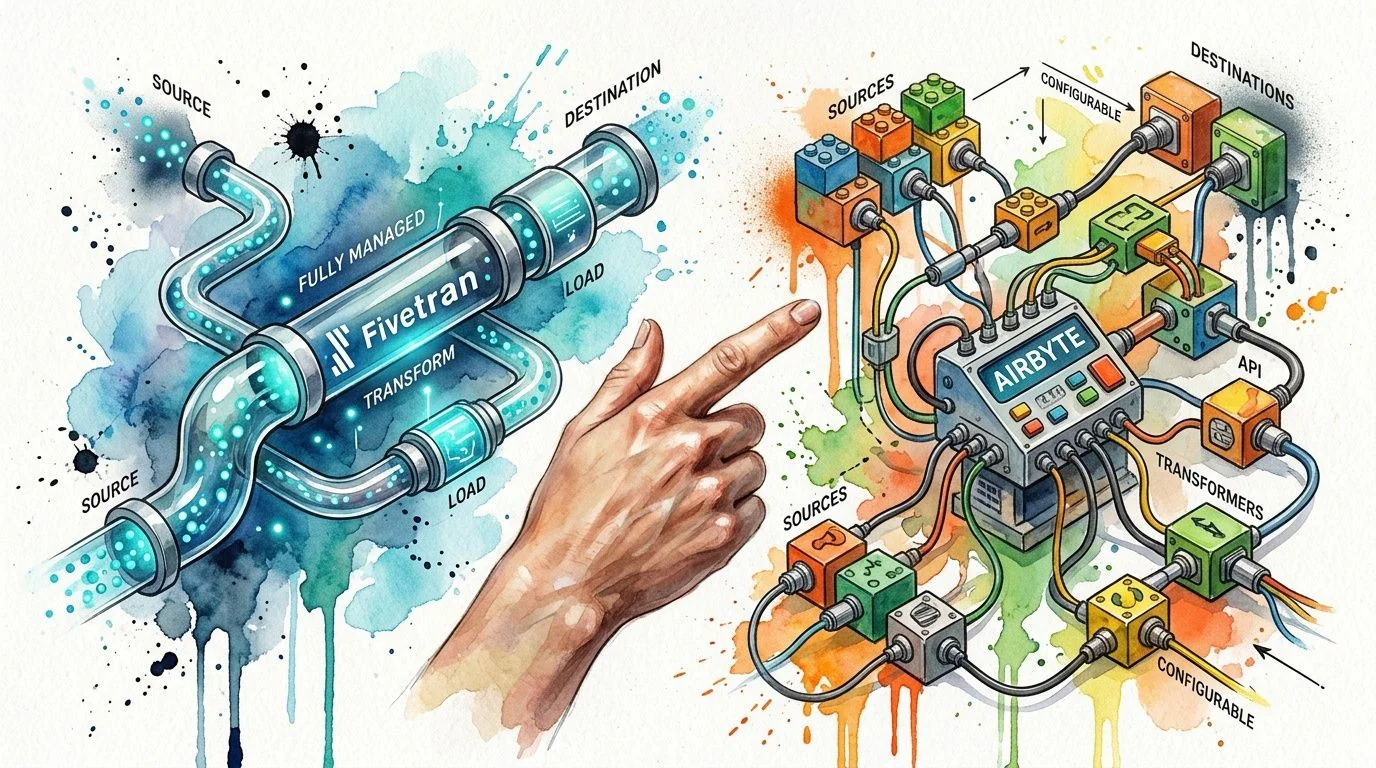
Architecture decides who carries the pager. If you need a broader refresher on the ingestion design choices around orchestration, transformations, and warehouse loading, this comparison of ETL tools is useful because it frames the tool choice inside full platform architecture rather than as a standalone procurement decision.
The implication is straightforward:
- With Fivetran, the vendor owns more of scaling, connector upkeep, and runtime reliability.
- With Airbyte Cloud, you get a partial transfer of that burden.
- With self-hosted Airbyte, your team owns much more of the platform surface.
Security and compliance review
For regulated environments, architecture affects approval speed as much as features do.
A managed service usually shortens review on infrastructure operations because fewer runtime components sit inside your estate. A self-hosted platform often gives security teams more control over deployment boundaries, but it also gives them more to inspect: cluster configuration, secrets handling, upgrade discipline, logging, patching, and network patterns.
Many teams underestimate the cost of “more control.” Security organizations don’t just want control. They want evidence that the control is implemented consistently.
When the ingestion platform is self-hosted, the question isn’t whether you can secure it. The question is whether you can secure it repeatedly during upgrades, incidents, and team turnover.
Team shape changes with the tool
The tooling choice changes who you need to hire or borrow from adjacent teams.
| Deployment concern | Fivetran impact | Airbyte impact |
|---|---|---|
| Platform operations | Lower internal burden | Higher burden, especially self-hosted |
| Kubernetes expertise | Usually minimal | Material requirement for self-hosted scale |
| Incident ownership | More vendor-led | More internal, especially for custom sources |
| Upgrade management | Mostly outsourced | Internal planning and testing burden |
That means Airbyte isn’t just a product choice. It’s a staffing decision. If your data engineering team already depends on a central platform or SRE function, Airbyte can fit cleanly. If your data team is expected to move quickly with limited infrastructure support, the same choice becomes friction.
The architectural consequence most teams miss
The longer your source estate grows, the more architecture turns into governance. Every new connector becomes part of a control surface involving lineage, access, SLAs, and failure response.
A managed platform keeps that surface tighter. A framework expands it. Neither is inherently better, but only one of them reduces the number of systems your own team has to operate.
Does a bigger connector catalog actually mean a better fit for your stack?
Connector count is a weak proxy for enterprise fit. What matters is the percentage of production-safe connectors for the systems tied to revenue, finance, compliance, and executive reporting - not the total number of logos on a comparison page.
Airbyte’s larger catalog and low-code CDK make it attractive for teams with niche SaaS tools, internal APIs, or proprietary systems. That flexibility is real. It also shifts more responsibility to your engineers, because a connector only creates value if it stays current as source schemas, authentication methods, and API limits change.
For enterprise use, a connector should be evaluated on:
- Maintenance ownership. Who patches the connector when the source platform changes behavior?
- Schema evolution handling. Does it absorb source changes cleanly, or does your team have to rework ingestion logic and downstream models?
- Security controls. Are features such as column-level blocking or hashing available natively?
- Support model. Is production support handled through a vendor SLA or a community issue queue?
- Operational predictability. Can the connector be trusted for regulated or business-critical datasets?
Those criteria matter more than the raw number of logos on a comparison page. A broad catalog increases option value. It does not reduce operating cost unless the connectors are consistently maintained. For a broader framework on evaluating integration tooling beyond the connector list, see data integration best practices.
Fivetran is stronger where standardization matters. Its vendor-maintained connectors for common enterprise systems reduce the odds that your team spends time tracing failures caused by source-side API changes or unexpected schema drift. That has second-order effects: fewer ingestion surprises means less rework in dbt, fewer broken dashboards, and fewer hours lost to cross-team incident coordination.
Airbyte is stronger where customization is part of the job. If you need to ingest an internal product API, support a niche application with limited market demand, or treat connectors as code inside your own platform engineering practice, Airbyte’s CDK gives you a path that managed SaaS products usually don’t.
That advantage has a cost profile many teams understate.
A custom or community connector can be inexpensive to start and expensive to keep. Every source change becomes an internal maintenance event. Every production incident requires someone who understands the connector code, deployment environment, and downstream dependencies. In small volumes, that’s manageable. Across dozens of connectors, it turns into recurring platform work.
A connector you can build quickly is not automatically a low-cost connector. The cost shows up later, in maintenance ownership, incident response, and upgrade testing.
A better procurement lens
Ask each vendor, or your implementation partner, to classify connectors source by source.
| Connector question | Why it matters |
|---|---|
| Is it vendor-maintained or community-maintained? | Defines who owns break-fix work |
| How are source schema changes handled? | Affects downstream model stability |
| Which security controls are native? | Influences governance and approval effort |
| What support path exists in production? | Shapes time to resolution during incidents |
| Is the connector approved for regulated or high-impact data? | Separates experimental coverage from production-grade coverage |
This reframes the decision from connector quantity to connector liability. Enterprises rarely fail because they lack a connector in theory. They fail because too many connectors become small systems their own team has to operate.
How reliable are Fivetran and Airbyte for enterprise-grade workloads?
Fivetran’s enterprise argument rests on managed reliability. Fivetran cites an IDC-commissioned study on its own comparison page claiming an average annual benefit of $1.5 million per organization, $177,000 in annual operational cost savings, and 48% more productive data engineers, alongside a 99.9% uptime SLA across its 700+ connectors (Fivetran vs Airbyte comparison). Treat vendor-commissioned figures like these as directional rather than independently audited.
Reliability is a staffing issue
Leaders often treat uptime as a technical metric. It’s also a people metric.
When pipelines break, someone has to:
- identify whether the problem sits in the source, connector, network path, warehouse, or transformation layer
- decide whether to retry, patch, backfill, or pause downstream jobs
- communicate impact to analytics, finance, product, and leadership
- absorb the cost of context switching across the engineering team
Fivetran reduces that burden by keeping connector operations inside the vendor boundary. Airbyte leaves more of it with your team, especially when self-hosted or when relying on community-maintained components.
The SLA nuance matters
It’s easy to compare headline uptime and conclude the gap is small. That reading is shallow.
The meaningful distinction isn’t only platform uptime. It’s connector-level enterprise support coverage. Airbyte’s cloud offering provides a 99% uptime SLA only on its “Airbyte Managed” connectors, which Fivetran’s own comparison materials put at roughly 15% of Airbyte’s source connectors (Fivetran vs Airbyte: features, pricing, services). That’s a competitor’s characterization of Airbyte’s catalog, so treat the exact percentage as approximate, but the underlying point is worth verifying directly with Airbyte: ask which of your specific connectors carry an SLA before you commit to them for business-critical data.
That variation is tolerable for experimentation. It’s a problem for payroll, revenue, regulated reporting, or migration-critical workloads.
Schema drift is where production trust is won
Most ingestion incidents don’t look dramatic at first. A source field changes. An API shifts behavior. A data type widens. Then a dbt model breaks, a dashboard goes stale, or a machine learning feature table drifts.
Fivetran’s position is stronger where automatic handling of schema and API changes is mandatory and where CDC depth matters in database migrations to Snowflake or Databricks. Airbyte can serve these environments too, but the operating discipline has to come from your own team.
Enterprise readiness isn’t a feature checklist. It’s the percentage of your ingestion estate that your organization can trust without heroic effort.
Where Airbyte is still viable
Airbyte remains a valid enterprise choice when reliability engineering is deliberate, not accidental. Teams that standardize self-hosting, maintain certified connector standards internally, and treat ingestion as a platform capability can make Airbyte work well.
But that’s a narrower set of organizations than most comparison posts admit. If your data team already struggles to keep Airflow, dbt, warehouse permissions, and observability in shape, adding ingestion runtime ownership will add to that pressure.
What’s the real total cost of ownership for Fivetran versus Airbyte?
The cheapest line item on a pricing page is often not the cheapest platform in production. A full TCO model has to include engineering time, infrastructure, connector maintenance, and security review, not just the invoice.
Why list pricing misleads buyers
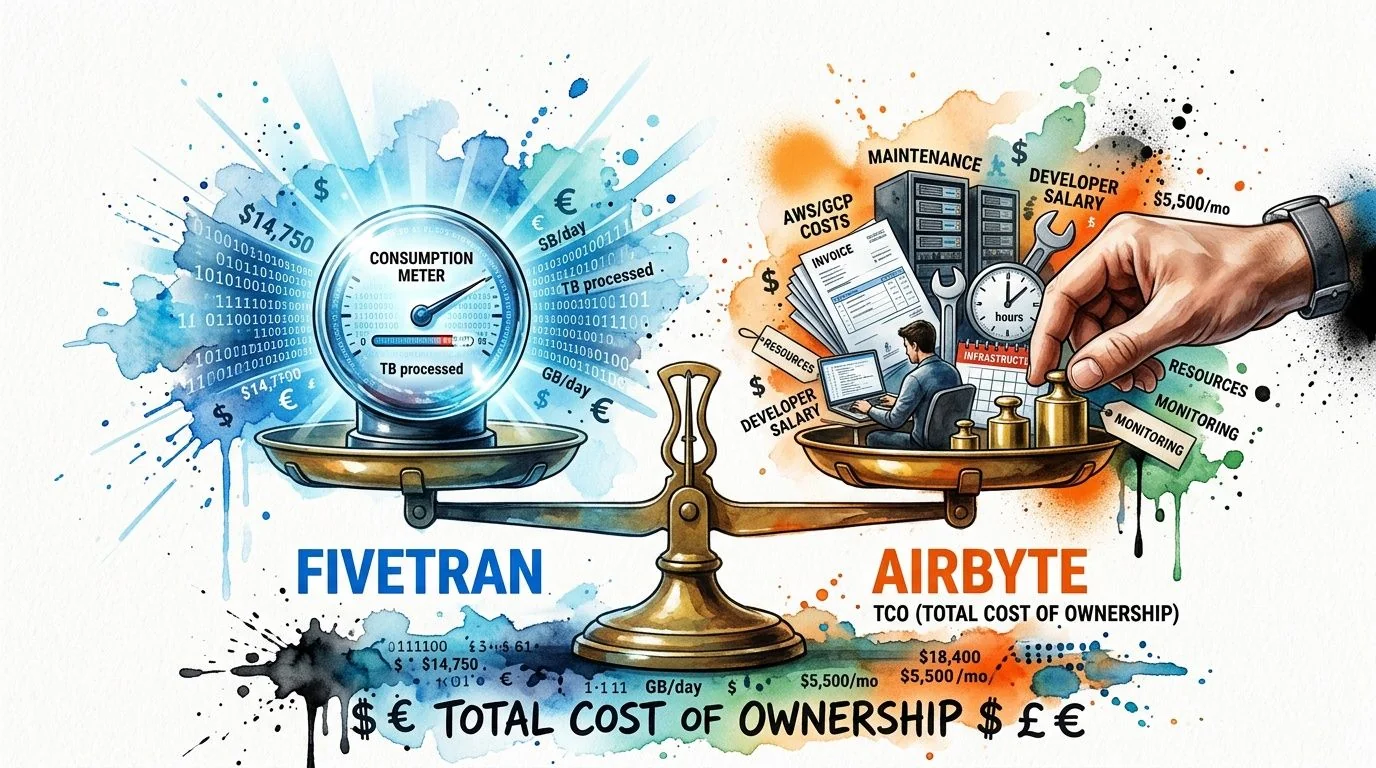
Airbyte’s low entry price and open-source posture make it look financially safer at first glance. Fivetran’s invoice is easier to notice because the vendor charges you directly. Airbyte often charges you indirectly, through engineering time, infrastructure, support processes, and reliability work that moves onto your team.
That distinction matters more than the starting subscription tier.
A realistic TCO model should account for:
- software or usage charges
- cloud infrastructure and networking
- platform engineering and SRE time
- connector maintenance and incident response
- security reviews, access controls, and compliance work
- delivery delays caused by ingestion instability
For teams estimating hosting and runtime costs, the AWS Pricing Calculator is useful because it forces infrastructure into the model instead of treating self-hosting as a rounding error.
The largest cost line is usually headcount
The central question isn’t whether Airbyte can cost less. It can. The question is under what operating conditions it stays less expensive over two to three years.
Self-hosting Airbyte shifts work onto internal teams, especially around Kubernetes operations, upgrades, and maintenance, while managed tooling reduces that burden by absorbing more of the runtime responsibility into the vendor service (Windsor’s comparison of Fivetran and Airbyte TCO walks through this tradeoff in more depth). For an enterprise, that difference changes staffing plans, on-call design, and the amount of senior engineering capacity tied up in plumbing rather than data products.
In this situation, many business cases break.
A buying committee sees a lower software line item and assumes savings. The actual result can be one more platform that needs ownership, escalation paths, patching windows, connector QA, and someone accountable when the CFO dashboard is wrong at 7 a.m. If your team already runs Airflow, dbt, warehouse performance tuning, IAM, and observability, ingestion runtime ownership isn’t free capacity. It’s a new operational surface area.
Build-versus-buy logic applies at the ingestion layer
The same economics behind broader platform decisions show up here in a smaller but more frequent form. Teams evaluating build versus buy for a modern data platform should apply the same discipline to ingestion, because connectors create recurring operational work, not one-time implementation work.
| TCO component | Fivetran | Airbyte |
|---|---|---|
| Budget predictability | Higher for team effort, lower for consumption spikes | Higher for software entry cost, lower for labor certainty |
| Infrastructure ownership | Minimal | Meaningful, especially self-hosted |
| Internal skill requirement | Data engineering and admin oversight | Data engineering plus platform ops, often Kubernetes |
| Cost volatility driver | Data volume, sync frequency, MAR-style pricing | Reliability work, connector upkeep, infra tuning, support load |
| Main financial risk | Vendor spend grows with usage | Internal labor grows with scope and criticality |
The non-obvious conclusion is that Airbyte becomes more attractive as your organization behaves more like a software platform company. If you already have strong internal SRE and platform engineering, and if ingestion ownership fits that operating model, Airbyte can be economically rational. If you don’t, its apparent savings can turn into hidden payroll and slower delivery.
Here’s a useful walkthrough before you finalize a financial model:
My TCO view as an architect
For standard enterprise ingestion, Fivetran often has the lower real cost even when the annual contract is higher. You’re buying fewer operational decisions, fewer failure modes, and fewer demands on scarce senior engineers.
Airbyte is the better economic choice in a narrower set of cases: unusual sources, a clear need for connector control, and a team that’s already staffed to run data infrastructure as an internal product.
The mistake is treating open source as free. In enterprise environments, open source often means you pay in labor, response time, and execution risk instead of paying the vendor invoice.
How do you actually decide between Fivetran and Airbyte?
Run the decision through operational criteria instead of product marketing. The checklist and RFP questions below are the two artifacts that make the choice defensible to a budget owner.
Fivetran vs Airbyte decision checklist
| Evaluation Criteria | Favors Fivetran | Favors Airbyte |
|---|---|---|
| Core sources are mainstream SaaS and databases | Yes | No |
| Need custom or proprietary connectors | No | Yes |
| Team has limited Kubernetes or platform ops capacity | Yes | No |
| Enterprise support consistency matters across production pipelines | Yes | No |
| Vendor neutrality is a strategic requirement | No | Yes |
| Goal is fastest path to stable Snowflake or Databricks ingestion | Yes | No |
| Team wants to own connector logic as code | No | Yes |
| Governance and compliance are prioritized over flexibility | Yes | No |
Questions to use in an RFP
Use these with vendors and implementation partners:
- Which required connectors are vendor-maintained versus community-maintained?
- How are schema changes handled without manual remediation?
- Who owns incident response for failed syncs in production?
- What skills must exist in-house on day one and after handover?
- What part of the runtime needs Kubernetes, DevOps, or SRE support?
- How will the tool fit with dbt, Airflow, Snowflake, Databricks, or BigQuery already in scope?
- What is the support path for regulated or business-critical data sources?
- What work remains internal after the consultancy exits?
Final recommendation
Choose Fivetran if your leadership priority is speed, predictability, and reduced operational burden. Fivetran’s own comparison materials lean into exactly this framing: automatic schema handling, 24/7 support on every connector, and consumption-based pricing are positioned as ways to compress rollout timelines and reduce migration risk (Fivetran vs Airbyte: features, pricing, services).
Choose Airbyte if you have a strong internal platform mindset, expect significant custom-source work, and want your engineers to own the ingestion layer as a strategic capability.
Buy Fivetran when ingestion is infrastructure you want to consume. Buy Airbyte when ingestion is infrastructure you want to operate.
For most enterprises, default to Fivetran unless there’s a clear connector or control requirement that justifies owning more of the stack.
How do you choose an implementation partner once you’ve picked a tool?
Your tool choice should dictate your partner shortlist. A Fivetran rollout partner needs to be excellent at source-to-target design, warehouse modeling, dbt conventions, governance mapping, and migration sequencing, with fast implementation and low drama as the core value. An Airbyte rollout partner needs that same data engineering skill plus comfort with platform operations, self-hosting patterns, release management, Kubernetes, and long-term support design.
According to DataEngineeringCompanies.com’s analysis of the 86 data engineering firms in the Index, the strongest partner selections come from matching the consultancy’s capability model to the operating burden of the tool, not just its badge list. Rates for this kind of work run $45 to $250 an hour across the Index, median around $100, so budget for that range before you scope the RFP - and weight it toward the higher end if you’re hiring for Airbyte’s platform-ops demands specifically. That distinction matters more with Airbyte because the implementation partner often shapes the runtime you’ll inherit.
If they can’t explain how they’ll operationalize connector ownership after handoff, they’re not the right partner.
A practical screen:
- For Fivetran projects, ask how they accelerate warehouse rollout and dbt adoption.
- For Airbyte projects, ask who owns upgrades, connector fixes, and cluster operations six months after go-live.
- For both, ask for a handover plan, governance model, and production support boundary.
If you’re evaluating firms for an Airbyte implementation specifically, start with this shortlist of data engineering consulting firms and screen for self-hosting and Kubernetes operations experience before you screen for connector count.
The next step is simple. Decide whether you want a managed ingestion service or an ingestion platform your team operates, then shortlist partners built for that exact operating model.
Researched & written by
Data-driven market researcher with 20+ years in market research and 10+ years helping software agencies and IT organizations make evidence-based decisions. Former market research analyst at Aviva Investors and Credit Suisse.
Previously: Aviva Investors · Credit Suisse · Brainhub · 100Signals
Vetted partners
Top Data Pipeline Partners
Vetted firms whose specialty matches this article.
More in Data Pipeline Architecture
Top Data Engineering Managed Services for 2026
Compare leading data engineering managed services. Find models, pricing, & vendors. Use our RFP checklist to select your ideal Snowflake or Databricks partner.
Data Reliability Engineering A Guide for CTOs
Learn what Data Reliability Engineering (DRE) is, why it matters, and how to implement it. A complete guide for leaders evaluating data engineering partners.
Build vs Buy Data Platform: An Engineering Leader's Decision Framework in 2026
Deciding on a build vs buy data platform? This guide provides a TCO model, performance benchmarks, and a decision framework for engineering leaders.