A Pragmatic Guide to Data Strategy Consultation for ROI
A data strategy consultation is a time-boxed engagement, typically 6 to 12 weeks, where an outside team audits your current data capabilities, defines a target architecture, and builds a phased execution plan tied to specific business outcomes: revenue growth, cost reduction, or a named AI initiative. The output isn’t a slide deck. It’s a plan that says what to build, in what order, and how you’ll know it worked.
This guide covers what a consultation should deliver, when it’s worth commissioning one, what it costs, and how to vet a vendor before you sign a Statement of Work. Rates vary sharply by engagement type and firm size, which is one reason vague proposals are hard to benchmark - more on that in the cost section below.
What this guide covers:
- The three-pillar deliverable structure - current-state audit, future-state roadmap, execution plan.
- The specific triggers that justify hiring outside help instead of building in-house.
- Realistic cost bands by consultant tier, and the contract models behind them.
- A vendor evaluation checklist and red-flag list for choosing a partner without getting burned.
What does a data strategy consultation actually deliver?
A competent engagement produces three things: an evidence-based audit of your current data stack and team skills, a future-state architecture blueprint tied to specific business goals, and a phased execution plan with a KPI framework attached - not a set of slide-deck recommendations you have to translate into action yourself.
You wouldn’t put up a building without an architectural plan. The architect doesn’t lay bricks, but the plan they produce determines whether the structure is sound, functional, and fit for purpose. A data strategy consultant plays the same role for your data ecosystem: they build the technical and operational roadmap that guides every subsequent data decision, investment, and project.
For any organization competing seriously in 2026, particularly given the demands of AI initiatives and multi-cloud platforms, this planning step isn’t optional. Without a coherent strategy, data initiatives fragment into expensive projects disconnected from the business needs they were meant to serve.
From ambiguous goals to a concrete roadmap
A primary function of a data strategy consultation is translating high-level business ambitions into an actionable plan. It forces the organization past generic goals like “become more data-driven” and into a specific, sequenced set of actions. The roadmap should specify what needs to be built, who owns it, and how success gets measured.
The table below summarizes the core deliverables you should expect from any competent data strategy engagement.
Core components of a data strategy engagement
| Component | Core Objective | Tangible Outcome |
|---|---|---|
| Current-State Assessment | Establish an objective, evidence-based baseline of current capabilities. | A detailed audit of existing data architecture, governance processes, and team skills, identifying critical gaps. |
| Future-State Vision | Define the target data ecosystem required to meet business objectives. | A collaboratively designed technical and operational blueprint for the ideal data platform, tailored to specific goals. |
| Value Realization Plan | Create the step-by-step implementation guide. | An actionable playbook detailing phased rollouts, talent requirements, and a KPI framework to measure ROI. |
This structured approach builds a sustainable data capability that delivers measurable results, rather than chasing whatever technology is trending that quarter.
Aligning technology with business value
Demand for this kind of guidance is significant. The Big Data Consulting Market, a key segment of data strategy consulting spend, is projected to reach USD 7.38 billion in 2025 and grow to USD 13.97 billion by 2030, according to Mordor Intelligence’s market report. That growth reflects a real need for organizations to get outside help modernizing data platforms in support of AI and other critical initiatives.
A successful consultation ensures that every dollar invested in data technology - whether for a cloud warehouse or an AI model - is tied to a specific, measurable business outcome. It cuts spending on technology for its own sake and directs resources toward initiatives that actually move the business.
The final output isn’t just a document. It’s a shared plan that turns data from a liability into a strategic asset.
What are the three pillars of a data strategy engagement?
Every effective data strategy breaks into three sequential phases: a diagnostic audit of what you have, a blueprint for what you need, and a phased plan for closing the gap - each tied to a measurable business outcome rather than a technology wish list.
This three-pillar structure keeps every action deliberate and every dollar invested tied to a quantifiable outcome. The goal is a direct line from technical data work to a measurable improvement in the bottom line.
Pillar 1: The current-state audit
You cannot map a route to a destination without knowing your starting point. The first pillar is a diagnostic analysis of your existing data ecosystem - a technical and operational audit where consultants act as objective investigators mapping your entire data environment.
This audit is a holistic review covering three areas:
- Technology and Architecture: An under-the-hood examination of your current data stack, pipelines, and storage. Consultants assess everything from ingestion methods to the performance and cost efficiency of your analytics platforms.
- Processes and Governance: How you manage, protect, and use your data - data quality protocols, access controls, and compliance with relevant regulations.
- People and Skills: A strategy is only as good as the people executing it. This component assesses the data literacy and technical capability of your teams to identify skill gaps.
The output is an objective, evidence-based report on what’s working, what’s broken, and where the biggest risks and opportunities sit. This foundation is non-negotiable for building a realistic strategy.
Pillar 2: The future-state roadmap
With a clear read on the “as-is,” the process shifts from diagnosis to design. This pillar builds a detailed blueprint for your ideal data environment - not a technology wish list, but a plan that aligns your data capabilities with your primary business goals over the next three to five years.
A critical part of this phase is making platform and tooling decisions. The roadmap determines whether a platform like Snowflake fits your business intelligence needs, or whether Databricks is the better fit for machine learning workloads. These calls should be grounded in the specific use cases identified during the audit, not vendor preference.
The future-state roadmap translates business objectives into a technical and operational blueprint. It answers the question: “What capabilities do we need to build to hit our revenue, efficiency, and growth targets?”
This blueprint details the target architecture, the required governance framework, and the team structure to support it - a shared plan that aligns everyone from the executive team to individual engineers.
Pillar 3: The value realization plan
The final pillar turns the strategic blueprint into a step-by-step execution plan. A roadmap that never gets implemented is worthless. This phase focuses on the practical “how” and “when,” breaking the future-state vision into sequenced, manageable projects.
This plan covers three operational details:
- Phased Implementation: A rollout schedule that prioritizes quick wins to build momentum and prove early ROI, while working through larger foundational projects over time.
- Talent Development: The training and hiring needed to close skill gaps identified in the audit, so the team is ready for new technologies and processes.
- KPI Framework: Clear metrics that track progress and tie every activity back to business value - the evidence needed to prove the investment’s ROI.
This pillar is what turns a data strategy consultation into a living playbook rather than a one-time report.
When should you bring in a data strategy consultant?
Three situations reliably justify the cost: a major cloud or platform migration, an AI initiative sitting on a shaky data foundation, or a data-quality problem that’s already undermining decisions. Waiting past any of these points usually costs more than the engagement would have.
You are planning a major cloud or platform migration
Migrating to a new platform - moving to Snowflake, for example, or modernizing a legacy warehouse - is far more than a simple lift-and-shift. Without a clear strategic roadmap, these projects routinely exceed budget, miss deadlines, and fail to deliver the value they were sold on.
A consultant acts as the architect hired before construction begins. Their job is to make sure the new platform is designed not just for current needs but for scale as AI and other future requirements arrive, and to help you avoid architectural mistakes that lock you into an inefficient system for years.
You are launching an AI initiative on a weak data foundation
AI and machine learning models are only as good as the data behind them. A common and expensive mistake is investing heavily in AI talent and tools before fixing foundational data issues. If your data is siloed, inconsistent, or untrustworthy, the AI initiative is set up to fail before it starts.
This is exactly the scenario a data strategy consultant is built for. They start with a realistic assessment of your data ecosystem:
- Data Quality Audit: Identify and quantify the data quality issues that will undermine your models.
- Pipeline Design: Design the automated data pipelines your data science team actually needs.
- Governance for AI: Establish the processes needed to track data lineage and monitor model accuracy over time.
This preparatory work is what gives an AI investment a realistic shot at ROI.
Poor data quality is undermining decision-making
If meetings are consumed by debates over whose numbers are right, or executives have stopped trusting the reports in front of them, that’s a data integrity crisis, not a technical inconvenience. It leads to flawed strategies, missed opportunities, and wasted resources.
When trust in data erodes, decision-making reverts to gut instinct, and the investment in analytics tools and talent stops paying off. A consultant is brought in to rebuild that trust by finding the root cause and implementing a durable fix.
They’ll help establish a data governance framework, assign clear ownership for key data assets, and put systems in place to keep data accurate and consistent - making reliable data the default rather than the exception. Demand for this kind of work is a real driver of consulting-market growth: the global consulting market is projected to grow from USD 1.06 trillion to USD 1.32 trillion by 2029, with data specialists representing a meaningful share of that expansion, according to Expert Network Calls’ 2025 consulting industry outlook.
What does a data strategy consultation actually cost?
Costs track scope, complexity, and the seniority of the team assigned - a well-defined, four-week technology audit costs far less than a twelve-week engagement that also redesigns your governance model and trains your team. Aligning on a pricing model upfront keeps the partnership matched to your budget, timeline, and risk tolerance.
Common engagement structures
A proposal’s price is always tied to a specific engagement model, and each model fits different kinds of projects:
- Time & Materials (T&M): A flexible pay-as-you-go model billed on actual hours worked. It fits projects with undefined scope - initial discovery, or complex problem analysis - but carries the risk of budget overruns if hours aren’t closely managed.
- Fixed-Price Project: A set price for a clearly defined scope and deliverable list. It offers budget predictability and suits well-understood projects like a current-state audit or roadmap development. The main risk is scope creep: anything outside the original agreement triggers a change order and additional cost.
- Retainer: A set monthly fee that reserves a block of a consultant’s time for ongoing advisory work. This fits long-term guidance after the strategy phase - overseeing implementation, or acting as an advisor to a data governance council.
For a closer look at how these models play out in practice, see our guide to data engineering consulting services.
Expected cost benchmarks
A single price for a data strategy consultation doesn’t exist, but the bands below, based on provider type, are a reasonable way to benchmark a proposal and spot an outlier.
The table below covers common hourly rates and typical project fees for an engagement spanning 4-8 weeks.
| Consultant Tier | Typical Hourly Rate (USD) | Typical Project Fee (4-8 Weeks) |
|---|---|---|
| Independent/Freelance | $150-$300 | $25,000-$60,000 |
| Boutique/Specialist Firm | $250-$450 | $60,000-$150,000 |
| Global Consulting Firm | $400-$800+ | $150,000-$500,000+ |
These figures shift with geography, the seniority mix of the team, and how specialized the technical skills required are - a project needing niche MLOps expertise will command a premium over a general assessment.
Note these bands are for high-level strategy engagements, not the hands-on data engineering work that typically follows. Among the 86 firms profiled in the Data Engineering Companies Index, hourly rates for build-and-implementation work run $45-$250, with a median around $100 - useful context if a strategy proposal quotes $400+/hour for what turns out to be mostly discovery and workshops.
It helps to reframe this spending. A data strategy consultation isn’t a project expense - it’s an investment in the organization’s decision-making infrastructure, one that should generate ROI well beyond its initial cost through improved efficiency, new revenue streams, and reduced risk.
What should a vendor evaluation checklist for a data strategy consultant include?
Score every candidate on three axes: platform and tooling expertise, industry-specific experience, and delivery methodology. Request named team bios, real case studies with quantified outcomes, and a documented communication cadence before you sign anything.
This checklist gives you a vendor-agnostic framework for comparing partners on what actually matters. Build these criteria into your Request for Proposal and use them as a scorecard during interviews - the goal is a choice based on demonstrated capability, not a polished pitch.
Technical expertise and platform fluency
First: can they actually execute the work? A competent data strategy consultant needs deep, demonstrable expertise in the technologies relevant to your current and future needs. Superficial familiarity is a red flag - you need a team with hands-on experience building real solutions.
Probe with specific questions:
- Platform Certifications: Do their consultants hold advanced certifications in platforms like Snowflake, Databricks, AWS, or Google Cloud? Ask for anonymized proof of the certified experts who’d actually be assigned to your project.
- Architectural Depth: Can they articulate the trade-offs between architectural patterns - data mesh versus a data lakehouse, for instance - and apply that thinking to your specific business context?
- Modern Data Stack Knowledge: Ask them to detail their experience across the full modern data stack, from ingestion (Fivetran, Airbyte) and transformation (dbt) to BI and visualization (Tableau, Power BI).
Industry specialization and contextual understanding
A generic data strategy is a failed data strategy. Your business has its own regulatory pressures, competitive dynamics, and operational complexity, and a consultant needs to understand that context before they can help. A partner with a track record in your industry will move faster and deliver a more relevant roadmap.
Look for evidence of real industry experience:
- Relevant Case Studies: Request detailed case studies from your industry - a high-level summary isn’t enough. You need the business problem, the solution implemented, and, most importantly, the quantifiable business outcomes achieved.
- Regulatory Knowledge: How have they handled compliance challenges specific to your field - HIPAA in healthcare, or GDPR for consumer data?
- Business Acumen: Do they understand your business well enough to discuss your challenges using your industry’s terminology and KPIs, not just technical jargon?
A consultant’s value isn’t just their technical skill - it’s their ability to apply it to your specific business problems. A firm that has solved similar challenges for your competitors brings a perspective and a playbook of what actually works in your market.
Delivery methodology and engagement style
How a consultant works matters as much as what they deliver. Their engagement model and communication style need to fit your team’s culture, or you get friction, missed deadlines, and a well-crafted strategy nobody ever implements.
Get clarity on their operational approach:
- Methodology: Do they run a rigid waterfall process or a more agile, iterative one? For data strategy, agile is usually the better fit - it lets the plan evolve as discovery surfaces new information.
- Communication Cadence: What’s their standard protocol - weekly status updates, stakeholder check-ins, executive presentations?
- Team Composition: Who’s actually doing the work? Insist on meeting the core team assigned to your project, not just the senior partner who closed the deal.
Scoring each potential partner against these criteria systematically turns a subjective choice into a data-driven decision. For a more structured version of this process, see our guide on how to choose a data engineering company.
What red flags signal a bad data strategy partner?
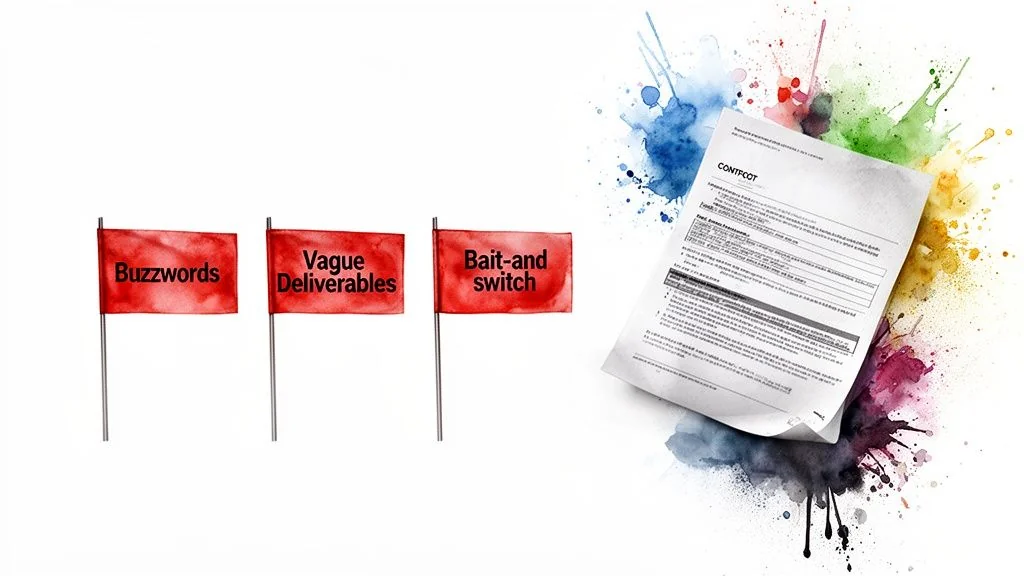
Watch for four warning signs: heavy buzzword use without concrete specifics, a rigid one-size-fits-all methodology, vague deliverables, and a bait-and-switch where the senior team that pitched you disappears after the contract is signed. Each one predicts a wasted engagement.
Selecting the wrong partner is more than a waste of money - it’s a setback that can derail your objectives for years. A polished sales presentation can mask a lack of substance, so approach these conversations with healthy skepticism.
They overuse buzzwords
Be wary of consultants who lean on jargon - “AI-powered synergy,” “digital transformation frameworks” - without connecting it to a concrete action or a measurable outcome for your business. It’s often a way to sound impressive while hiding a shallow understanding of the actual work. A good consultant simplifies complex ideas instead of dressing them up.
If a consultant can’t explain their value without industry buzzwords, they’re selling a trend, not a solution. Their job is to solve your specific problems, not to demonstrate their vocabulary.
Example: A vendor proposes an “AI-driven data fabric solution” but goes vague when asked which specific data sources it integrates, what business questions it answers, or how it improves a metric your team actually tracks.
They pitch a one-size-fits-all solution
If a potential partner presents a rigid, pre-packaged methodology as the only approach, that’s a problem. Every company has its own mix of data systems, business goals, and internal culture. A good data strategy consultation gets tailored to your reality, not forced into a template.
This inflexibility usually means they care more about scaling their internal process than about understanding your specific problem. The best partners listen first and adapt their approach second.
Their deliverables are vague
A strong proposal is specific about what you’ll actually receive. Promises like “enhanced data insights” or “a strategic roadmap” without further detail are a red flag.
- Look for: A detailed list of tangible artifacts - a Current-State Assessment with gap analysis, a Future-State Architecture Diagram, a phased implementation plan with clear milestones and timelines.
- Ask about: How success gets measured. A competent partner wants to collaborate on defining KPIs that tie the project directly to business value.
The bait-and-switch tactic
This is common and damaging. During the sales process you meet the firm’s senior experts, and their strategic vision impresses you. Once the contract is signed, they vanish, and the project gets handed to a junior team you’ve never met.
To prevent it, insist on meeting the actual people who’ll be working on your project before signing. Get their bios and, more importantly, get their specific roles and time commitments written into the Statement of Work. A successful partnership runs on that kind of transparency - the same principle covered in our guide to data engineering partner selection.
Common questions about data strategy consultation
How long does a data strategy consultation take?
Every engagement is different, but a comprehensive data strategy consultation typically falls in the 6 to 12-week range - enough time to deliver real value without turning into an open-ended project.
A typical timeline breaks down as:
- Weeks 1-3 (Discovery & Assessment): A deep dive into your current data systems, workflows, and team skills to establish an accurate baseline.
- Weeks 4-8 (Future-State Design): Collaborative design through workshops and working sessions to define the target architecture and build the roadmap.
- Weeks 9-12 (Finalization & Handoff): Findings get documented in a detailed implementation plan, including financial models (TCO/ROI), and the engagement wraps with a presentation of the playbook to leadership.
What is the difference between data strategy and data governance?
This distinction matters. Think of it as building a city.
Data strategy is the master blueprint - it answers the “what” and “why.” It decides which districts get built (sales analytics, operational dashboards), explains why they matter to the city’s growth, and shows how they connect to the overall vision. It’s the high-level plan for using data to hit business objectives.
Data governance, by contrast, is the building codes, zoning laws, and inspectors - the “how.” It sets the rules, standards, and controls that keep every structure safe, reliable, and functioning correctly. Governance is what makes your data accurate, secure, and trustworthy. See our data governance strategies guide for how to build that layer, following practices similar to what Snowflake’s access control model and Databricks Unity Catalog are both built to enforce.
You can have a brilliant strategy, but without a solid governance foundation underneath it, it will eventually fail.
Why can’t our internal team build its own data strategy?
Your internal team has business knowledge you can’t buy. But an external consultant brings capabilities that are hard to replicate in-house. An effective data strategy consultation combines your team’s institutional knowledge with an outside expert’s broader perspective - see our comparison of data engineering consulting vs. in-house teams for how that trade-off plays out in practice.
Consultants offer three specific advantages:
- Cross-Industry Experience: They’ve seen what works - and what doesn’t - at other companies, and bring proven solutions that help you skip common, costly mistakes.
- Dedicated Focus: Your internal team is juggling daily operational work. A consultant’s only job is delivering a high-quality strategy on schedule.
- Objective Neutrality: Every organization carries internal politics and biases. An outside partner can challenge long-held assumptions and build consensus across departments without being tangled in internal dynamics.
The point of a consultation isn’t to replace your team - it’s to strengthen it. The best outcome combines an expert’s broad experience with your team’s deep business understanding, producing a better strategy in a fraction of the time it would take to build alone.
Turning the strategy into a vendor decision
A data strategy consultation is only worth the cost if it ends in a roadmap someone actually executes. Use the three-pillar deliverable structure to judge a proposal, the cost bands above to sanity-check the price, and the red-flag list to catch a mismatched partner before you sign. If you’re ready to compare firms directly, browse vetted profiles in the Data Engineering Companies Index.
Researched & written by
Data-driven market researcher with 20+ years in market research and 10+ years helping software agencies and IT organizations make evidence-based decisions. Former market research analyst at Aviva Investors and Credit Suisse.
Previously: Aviva Investors · Credit Suisse · Brainhub · 100Signals
Vetted partners
Top Enterprise Partners
Vetted firms whose specialty matches this article.
More in Enterprise Data Engineering
Data Engineering Vendor Evaluation Criteria: 35 Criteria for 2026
The complete 35-criterion evaluation framework for choosing a data engineering vendor in 2026 - definitions, verification, red flags, and weighting.

Data Engineering for SaaS Companies: Leaders' 2026 Guide
Elevate your data engineering for SaaS companies. This guide covers multi-tenancy, cost, vendor selection, & platform modernization for leaders.
Data Engineering Partner Selection: The 2026 Five-Stage Framework
A 2026 framework for data engineering partner selection: pre-RFP signal scan, sourcing, evaluation, paid pilot, contract, and 90-day handover.