10 Actionable Data Pipeline Testing Best Practices for 2026
In 2026, data pipeline execution is a commodity. The strategic differentiator is the verifiable integrity of the data that flows through them. A pipeline that “runs successfully” is not the same as a pipeline that produces correct, reliable data. This distinction is the core of modern data engineering. When pipelines fail, they rarely do so with a loud bang; instead, they introduce subtle, silent corruptions that erode analytics, undermine business intelligence, and lead to flawed strategic decisions.
Building trust in data requires moving beyond basic operational checks to a rigorous, multi-layered testing strategy. This article presents 10 essential data pipeline testing best practices that form the bedrock of any high-performing data operation. This is an actionable blueprint for implementing a robust testing framework, covering everything from granular unit tests for transformation logic to advanced chaos engineering that confirms system resilience.
These are not theoretical concepts. The goal is to equip data engineers, architects, and technical leaders with a clear guide to building, evaluating, and maintaining data pipelines that are not just functional, but fundamentally trustworthy. By mastering these practices, you transform your data infrastructure from a mere utility into a strategic asset that delivers consistent, verifiable value.
1. Data Quality Validation Testing
At its core, data pipeline testing aims to ensure the information flowing through your systems is reliable. Data quality validation testing is the frontline defense, acting as an automated gatekeeper that verifies the accuracy, completeness, consistency, and timeliness of your data at critical checkpoints. To lay a solid foundation for robust data pipelines, it’s essential to understand what data quality testing entails. This practice involves defining and enforcing specific rules before data is loaded into downstream systems like data warehouses or analytics platforms.
The primary benefit is preventing the “garbage in, garbage out” syndrome that erodes trust in analytics. By catching issues like null values in critical fields, incorrect data types, or duplicate records early, you protect the integrity of your entire data ecosystem. Frameworks like Great Expectations, Soda, and dbt’s built-in testing capabilities are central to implementing this practice. For instance, a retailer might use Great Expectations to automatically confirm that every customer transaction record has a valid order_id and that the transaction_amount is a positive number before loading it into Snowflake.
Actionable Implementation Tips
- Prioritize by Business Impact: Begin by defining data quality rules for the most critical data elements that directly affect key business outcomes. Do not attempt to validate everything at once.
- Layer Your Validations: Implement checks in stages: first, basic schema validation (data types, column names), then business logic checks (e.g., order status transitions), and finally, statistical anomaly detection (e.g., an unusual spike in daily sales). This layered approach provides more targeted feedback.
- Set Realistic Thresholds: Configure your tests to balance sensitivity with the risk of false positives. A rule that fails a pipeline for a single null value in a non-critical field can cause more disruption than it prevents.
- Visualize Quality Metrics: Create dashboards to track validation results, failure rates, and data quality trends over time. This provides visibility to stakeholders and helps quantify the health of your data assets. For a deeper dive, explore best practices for managing data quality across your organization.
2. Unit Testing for Data Transformations
Applying software engineering discipline to data pipelines is essential, and unit testing for data transformations is a foundational practice. It involves testing individual transformation functions or SQL models in complete isolation. By feeding a small, controlled, and predictable dataset into a piece of transformation logic (like a Python function or SQL query), you can verify that it produces the exact expected output. This is one of the most effective data pipeline testing best practices for ensuring the reliability and correctness of your code before it interacts with other parts of the system.
This approach isolates the logic, removing dependencies on live databases or APIs, which makes tests fast, repeatable, and deterministic. The core benefit is catching bugs in your business logic at the earliest, most inexpensive stage. For teams working on platforms like Databricks or Snowflake, where complex transformations are central to value creation, robust unit testing is not optional. For example, a Databricks team can use pytest to validate a complex PySpark function that calculates customer lifetime value, ensuring it handles edge cases like new customers or returns correctly before it’s ever run against production-scale data.
Actionable Implementation Tips
- Use Framework-Specific Tooling: For SQL-based transformations, lean on
dbt testto validate assumptions directly within your models (e.g.,unique,not_null,relationships). For Python or Scala code in environments like Databricks, use standard testing libraries such aspytestorScalaTest. - Test for Edge Cases, Not Just the “Happy Path”: Your unit tests should deliberately cover scenarios like null inputs, empty data frames, duplicate records, and extreme or unexpected values. This is what separates fragile pipelines from resilient ones.
- Mock External Dependencies: To achieve true isolation, mock any calls to external systems like databases, APIs, or other microservices. This ensures your test is evaluating only the transformation logic itself, not the state of its dependencies.
- Integrate into CI/CD: Embed unit tests directly into your continuous integration (CI) pipeline. Configure your workflow to automatically run these tests on every commit and block any code from being merged if the tests fail, preventing broken logic from ever reaching production.
3. Integration Testing for Pipeline End-to-End Flows
While unit tests validate individual pipeline components, integration testing ensures these components function correctly as a collective system. This practice is crucial for testing complete data pipeline flows from ingestion through transformation to final output, using realistic data and dependencies without mocking internal connections. It is one of the most critical data pipeline testing best practices for exposing issues that only appear when disparate systems interact.
This testing method validates that all the moving parts, such as connectors, transformation scripts, and loaders, work together as designed. The core benefit is catching integration failures, like mismatched schemas between stages or misconfigured permissions, that isolated component tests would miss. For instance, a data platform team might test a Databricks medallion architecture by running a job that processes raw data from a landing zone (bronze), applies business rules to create a clean dataset (silver), and aggregates it for analytics (gold), verifying the end-to-end flow. Similarly, an e-commerce company could validate a pipeline that ingests data from Shopify, Salesforce, and a custom event stream, transforms it in Snowflake, and loads the result into a BI tool.
Actionable Implementation Tips
- Mirror Production Environments: Create separate staging or QA environments that closely replicate your production configuration, including network rules, access permissions, and resource allocation. This ensures your tests are representative of real-world conditions.
- Use Realistic Data Subsets: Run integration tests against recently refreshed, anonymized subsets of production data. This approach provides a realistic test bed for data volume and complexity without compromising data privacy.
- Test Failure and Recovery: Intentionally test error scenarios to validate your pipeline’s resilience. Simulate failed API calls, network timeouts, or malformed data to ensure your error handling and recovery procedures function as expected.
- Validate Stage-by-Stage Integrity: Implement checks for row counts and checksums between key pipeline stages. A discrepancy between the source record count and the count after an ETL join can quickly pinpoint data loss or duplication issues. More details on how these components fit together can be found when exploring modern data pipeline architecture.
4. Schema Validation and Evolution Testing
Data pipelines often break not because of bad data values, but because the structure of the data itself changes unexpectedly. Schema validation and evolution testing directly addresses this “schema drift,” creating a framework to detect and manage changes in data structure. This practice ensures your pipelines can gracefully handle added or removed fields and data type changes without failing. Proper schema management is a critical component of modern data pipeline testing best practices, especially for platforms like Snowflake and Databricks that ingest semi-structured data where schemas can be fluid.
The core goal is to prevent structural surprises that break downstream processes, from ETL jobs to BI dashboards. When an upstream API adds a new field or a data feed changes a column from an integer to a string, schema tests act as an early warning system. This allows data teams to adapt proactively rather than reactively fixing broken pipelines. Tools like dbt (with its model contracts), Confluent Schema Registry, and Great Expectations are fundamental for implementing this. For instance, a marketing team ingesting ad platform data can use automated schema tests to flag when a new metric column is added, ensuring it’s mapped correctly before it causes mismatches in their analytics database.
Actionable Implementation Tips
- Implement Automated Schema Inference: For sources like JSON or Parquet, use tools that can automatically infer the schema and compare it against a known-good version. This immediately flags any new, missing, or altered fields.
- Establish a Schema Registry: Create a centralized, version-controlled repository for your data schemas (e.g., using Apache Avro or Databricks Unity Catalog). This registry becomes the “source of truth” for what data structures your pipeline expects.
- Test for Breaking Changes: Configure your CI/CD pipeline to explicitly test for breaking schema changes. If a pull request modifies a data model in a way that removes a column or changes a data type, the build should fail, forcing a deliberate review and migration plan.
- Document and Version Schema Migrations: For any intentional, major schema change, document the migration procedure and assign a version number. This practice, borrowed from software engineering, brings discipline to data model evolution and simplifies rollbacks if needed.
5. Performance and Load Testing for Pipelines
Beyond data accuracy, data pipeline testing must ensure that your pipelines can handle real-world operational demands without breaking or slowing down. Performance and load testing directly addresses this by simulating various data volumes, frequencies, and concurrent processing scenarios to validate scalability and adherence to Service Level Agreements (SLAs). This practice ensures that pipelines complete within expected timeframes, resource utilization remains acceptable, and the system can handle peak demand without quality checks becoming bottlenecks.
The central benefit is building confidence that your data infrastructure will not fail during critical business periods. By proactively identifying performance ceilings and bottlenecks, you prevent system degradation that could delay vital analytics or cause outright failures. Tools like Apache JMeter and Locust, alongside native cloud benchmarking services, are instrumental in executing these tests. For instance, a retailer can stress-test its e-commerce data pipelines before Black Friday to ensure they can manage a 10x traffic spike, or a financial institution can validate that its daily risk calculation pipelines will complete within strict regulatory windows.
Actionable Implementation Tips
- Test with Production-Like Configurations: Use cluster sizes and configurations that mirror your production environment. Testing on underpowered infrastructure will yield misleading results and mask potential scalability issues.
- Simulate Concurrency: Don’t just test one pipeline in isolation. Run multiple pipelines concurrently to simulate a real-world scheduler’s workload and uncover resource contention problems (CPU, memory, I/O).
- Isolate and Stress Transformations: Identify the most computationally expensive or slowest transformations in your pipeline. Create specific tests that hammer these specific steps with large data volumes to find their breaking points.
- Monitor and Document Key Metrics: Track execution time, memory and CPU usage, and cloud costs during tests. This data is essential for making informed decisions about cluster sizing, auto-scaling policies, and performance tuning.
- Test Failure Recovery Under Load: A critical, often overlooked, aspect of data pipeline testing is verifying how the system recovers from a failure while under heavy load. Ensure that the pipeline can fail gracefully and resume without data loss or corruption. When considering the scalability and efficiency of your data pipelines, a deep dive into how to conduct effective load performance testing can provide valuable methods.
6. Regression Testing Automation
As data pipelines evolve, every code change, infrastructure update, or schema migration introduces the risk of unintentionally breaking existing functionality. Regression testing automation is a critical practice for maintaining pipeline reliability by systematically re-running a suite of tests to verify that new changes haven’t introduced defects, or “regressions,” in previously working components. This approach is fundamental to enabling rapid, confident iteration within a modern data stack.
The core benefit is building a safety net that allows development teams to move quickly without fear of causing downstream disruptions. By automating these checks, you ensure that known issues remain fixed and core business logic remains intact. For example, a data team using dbt can configure their CI/CD process to automatically execute a full test suite on every model change before it’s deployed to production. Similarly, changes to an Apache Airflow DAG can be validated against a set of historical test cases to confirm that data processing logic still behaves as expected.
Actionable Implementation Tips
- Start with High-Impact Scenarios: Don’t attempt to build a complete regression suite from day one. Begin by creating automated tests for the most critical pipeline paths and for every bug discovered in production. This ensures your most valuable data flows are protected first.
- Integrate with CI/CD: Embed your regression test suite directly into your continuous integration and continuous deployment pipeline. Use version control branching strategies, like feature branches, and configure your system to automatically block deployments when a regression test fails.
- Maintain High-Quality Test Data: Your regression tests are only as good as the data they run on. Maintain a stable, versioned set of test data that covers key business scenarios, edge cases, and historical anomalies, not just simple technical validations.
- Monitor Test Performance and Flakiness: A flaky test, one that passes and fails intermittently without any code changes, can erode trust in your test suite. Actively monitor test execution times and failure rates, and immediately investigate the root cause of any instability to keep the process reliable.
7. Data Lineage and Impact Analysis Testing
In complex data ecosystems, a change in one table can create unforeseen ripple effects downstream. Data lineage and impact analysis testing directly addresses this by verifying the accuracy of your pipeline’s dependency map. This practice involves documenting and validating the path data takes from source to consumption, confirming which transformations depend on specific tables and columns. It is a critical component of a mature testing strategy, especially for enterprise pipelines where understanding dependencies is essential for scoping tests and planning safe deployments.
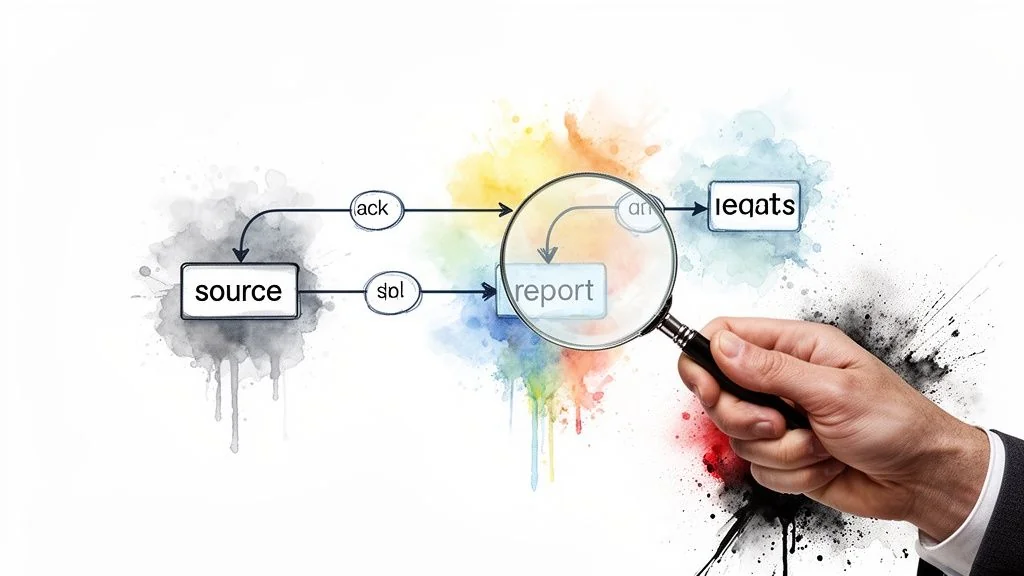
The primary advantage is enabling proactive risk assessment. Before deploying a change, you can precisely identify all affected downstream models, dashboards, and reports, preventing unexpected breakages. For instance, a financial services platform must track lineage from source transaction systems through multiple risk calculations to final regulatory reports to prove data integrity. Tools like dbt, with its native graph visualization, and data governance platforms like Atlan or Collibra are central to this practice. They automate the discovery and mapping of these relationships, making one of the most important data pipeline testing best practices manageable at scale.
Actionable Implementation Tips
- Start with Automated Lineage Capture: Use the built-in lineage features of your tools. dbt’s graph visualization, Databricks Unity Catalog, and Snowflake’s access history provide immediate dependency insights with minimal manual effort.
- Integrate Lineage into Code Reviews: Make it a standard practice for developers to review the dbt graph or lineage diagram as part of every pull request. This helps catch unintended dependencies or circular references before they are merged.
- Use Lineage for Targeted Testing: When a source table or an upstream model changes, use the lineage graph to define the exact scope of your integration and regression tests. This focuses testing effort where it’s most needed and accelerates release cycles.
- Maintain a Data Dictionary: Supplement automated lineage with business context. A data dictionary should document not just the technical path but also the business purpose of transformations, providing a complete picture for auditors and new team members.
8. Snapshot Testing and Idempotency Validation
While unit tests check individual components and quality tests validate data contents, another layer of assurance is needed to confirm that your pipeline’s output remains consistent over time. Snapshot testing and idempotency validation provide this stability check. This practice ensures that running a pipeline multiple times with the same input data produces identical results (idempotency) and that unintended changes to complex logic are caught by comparing outputs against a stored “snapshot” of a known good result.
This method is one of the most effective data pipeline testing best practices for catching subtle but critical regressions. It captures an expected output state, such as a final report or a machine learning feature set, and automatically flags any deviation in subsequent runs. This is vital for maintaining reliable, repeatable data processes where even minor changes in business logic can have significant downstream consequences. Tools like dbt’s snapshot macro, which helps manage slowly changing dimensions (SCDs), have popularized this concept by tracking historical changes in dimensional data.
Actionable Implementation Tips
- Focus on Critical Outputs: Don’t snapshot everything. Start by capturing snapshots for high-impact transformation outputs like key business metric tables, final aggregated reports, or feature tables used in production ML models.
- Implement Hash-Based Comparisons: For very large datasets, storing and comparing full snapshots is inefficient. Instead, generate a hash (e.g., MD5) of the output data and compare the hash values. A change in the hash indicates a change in the data.
- Exclude Non-Deterministic Fields: Your comparisons will consistently fail if you include fields that naturally change on every run, such as
last_updated_timestampor randomly generated IDs. Exclude these columns from your snapshot comparisons to avoid false positives. - Version Your Snapshots: Treat your snapshots like code. Store them in version control (like Git) alongside your pipeline code. When an intentional change is made, update the snapshot and commit it as part of the same release, creating a clear audit trail.
- Establish a Review Process: Create a workflow for reviewing and approving snapshot changes. When a test fails, a developer or data analyst must determine if the change was intentional (a valid logic update) or a bug. If intentional, the new snapshot is approved and becomes the new baseline.
9. Chaos Engineering and Resilience Testing
Data pipelines operate in complex, distributed environments where failures are inevitable. Chaos engineering moves beyond traditional testing by intentionally injecting failures into your pipeline’s infrastructure to see how the system responds and recovers. This proactive practice is a core tenet of modern data pipeline testing best practices, simulating real-world problems like API timeouts, resource constraints, or sudden data inconsistencies to validate the effectiveness of your error handling, retry logic, and recovery mechanisms.

The central benefit is building genuine confidence that your pipelines will remain operational despite unpredictable production issues. Popularized by Site Reliability Engineering (SRE) practices and tools like Chaos Monkey, this approach hardens your system against partial outages. For example, an e-commerce platform could simulate the failure of a third-party shipping API to confirm that its pipeline correctly reroutes orders to a backup provider or queues them for later processing without data loss. Similarly, a data team could test a cloud data warehouse by simulating a cluster node failure to verify that jobs are automatically rescheduled and data integrity is maintained post-recovery.
Actionable Implementation Tips
- Start in Pre-Production: Never begin chaos testing in a live production environment. Isolate your experiments to staging or development environments to understand the impact without affecting real users or business operations.
- Document Failure Scenarios: Before injecting any failures, clearly define the expected behavior. What should happen when a database connection drops? How should the system recover? This documentation becomes your test case.
- Establish a Baseline with Monitoring: Implement comprehensive monitoring and alerting before starting chaos tests. You need clear visibility into the system’s steady state to accurately measure the impact of an injected failure and confirm that alerts trigger as expected.
- Validate Recovery and Consistency: The test doesn’t end when the system comes back online. The crucial final step is to validate that all data is consistent and complete after the recovery process, ensuring no records were dropped or corrupted.
- Schedule Regular Chaos Days: Treat resilience testing as a recurring event, not a one-time check. Schedule regular “chaos days” or automated experiments quarterly to continuously validate that new code changes or infrastructure updates haven’t introduced new weaknesses.
10. Observability and Test-Driven Monitoring
Effective data pipeline testing extends beyond verifying data quality; it must also ensure the pipeline itself operates reliably. Observability and test-driven monitoring shifts the paradigm from reactive firefighting to proactive issue detection by building monitoring and alerting directly into the testing strategy. This practice treats observability as code, where you write tests to validate that your monitoring systems are capturing the correct metrics, logs, and traces needed to rapidly diagnose failures. By doing so, you confirm that your diagnostic tools will actually work when you need them most.
The core benefit is creating a self-aware system that can signal problems before they cause significant downstream damage. This approach involves defining expected behavior and automatically testing against it, which is crucial for maintaining trust in complex, distributed data architectures. For example, a data platform team might monitor pipeline execution duration and configure automated alerts to trigger when a job takes 150% longer than its historical baseline. Similarly, a transformation team could track row count metrics at each stage of a dbt project, using anomaly detection to flag unexpected drops or spikes that indicate data loss or duplication. Exploring the principles of what data observability is provides a solid foundation for implementing this practice.
Actionable Implementation Tips
- Define Baselines and Test Thresholds: Establish baseline performance metrics (e.g., execution time, CPU usage, data volume) for every pipeline under normal conditions. Implement tests that confirm alerts trigger at appropriate thresholds (e.g., a Z-score > 3) without generating excessive false positives.
- Implement Structured Logging: Enforce a structured logging format (like JSON) with consistent field names across all pipeline components. This makes logs easily queryable and allows you to write tests that validate specific events are being logged correctly during pipeline execution.
- Use Distributed Tracing: In multi-component or microservices-based pipelines, implement distributed tracing using standards like OpenTelemetry. This allows you to trace a single data record’s journey across various systems, which is invaluable for pinpointing bottlenecks or failure points.
- Link Alerts to Runbooks: Create clear, actionable runbooks that detail the steps for resolving specific alerts. Associate each alert directly with its corresponding runbook to reduce mean time to resolution (MTTR) and ensure a consistent response from the on-call team.
10-Point Comparison of Data Pipeline Testing Best Practices
| Practice | Implementation complexity | Resource requirements | Expected outcomes | Ideal use cases | Key advantages |
|---|---|---|---|---|---|
| Data Quality Validation Testing | Moderate–high: define/rule across stages | Validation frameworks, compute, monitoring | Prevents bad data, earlier error detection | Production pipelines, BI, regulated domains | Reduces downstream debugging, enforces SLAs |
| Unit Testing for Data Transformations | Low–moderate: per-transformation tests | Test frameworks, dev time, test fixtures | Correct transformation logic, fast feedback | dbt/Snowflake/Databricks development | Fast feedback, safe refactoring, CI support |
| Integration Testing for Pipeline End-to-End Flows | High: full-path execution and orchestration | Staging env, production-like data, time | Validates handoffs, uncovers integration faults | Complex multi-component pipelines, vendor evaluation | Catches issues missed by unit tests, verifies lineage |
| Schema Validation and Evolution Testing | Moderate: schema capture and drift rules | Metadata store, schema registry, tooling | Detects schema drift, prevents structural breaks | Semi-structured data, evolving APIs, IoT feeds | Enables graceful evolution, improves governance |
| Performance and Load Testing for Pipelines | High: stress and sustained load scenarios | Production-scale infra, load generators, monitoring | Ensures scalability, identifies bottlenecks | Peak traffic events, SLA-critical jobs | Informs capacity planning, uncovers performance limits |
| Regression Testing Automation | Moderate–high: maintain comprehensive suites | CI/CD, baseline datasets, test maintenance | Prevents regressions, supports rapid deployments | Frequent releases, mature engineering teams | Blocks unintended changes, documents expected behavior |
| Data Lineage and Impact Analysis Testing | Moderate: capture and validate metadata | Lineage tools, metadata capture, catalogs | Maps dependencies, enables targeted testing | Large enterprise pipelines, change management | Enables impact analysis, reduces blind deployments |
- | Snapshot Testing and Idempotency Validation | Moderate: capture and compare outputs | Snapshot storage, diff tools, hashing | Detects subtle output changes, ensures idempotency | SCDs, reporting outputs, ML feature pipelines | High confidence in outputs, catches subtle regressions | | Chaos Engineering and Resilience Testing | High: controlled failure injection practice | Failure injection tools, monitoring, safe envs | Validates recovery, exposes hidden failure modes | Mission-critical systems, resilience maturity programs | Reveals single points of failure, improves recovery | | Observability and Test-Driven Monitoring | Moderate: monitoring-as-code and tests | Observability stack, dashboards, alerts | Faster detection and diagnosis, continuous metrics | Production monitoring, SRE/DataOps practices | Proactive detection, reduces time-to-diagnosis and MTTD |
From Best Practices to Business Impact: Operationalizing Your Testing Strategy
The ten strategies explored share a common thread: treating data pipelines as product-grade software assets that demand rigorous engineering discipline. Implementing these practices is the mechanism that builds trust and reliability into your data infrastructure. The journey from inconsistent, manual validation to a mature, automated testing framework is a marathon, not a sprint. It’s about instilling a culture of quality where data developers own the reliability of their code.
Synthesizing the Core Principles
Distilling the ten practices down to their essence reveals a few core, non-negotiable principles for modern data pipeline testing:
- Automate Everything: Manual testing is a bottleneck and a point of failure. The goal is a “testing flywheel” where every code commit automatically triggers a cascade of validations—from unit tests on transformation logic to regression tests against production-like data—all within your CI/CD workflow.
- Test Data, Not Just Code: A pipeline can execute flawlessly yet still produce garbage data. Data quality validation, schema checks, and snapshot testing are paramount. Your tests must confirm not only that the pipeline runs but that it produces the correct data.
- Shift Left and Shift Right: Testing isn’t a final gate before deployment. “Shifting left” means building in unit and data quality tests during development. “Shifting right” means using production observability, monitoring, and chaos engineering to continuously validate pipeline health in its live environment.
- Embrace Progressive Implementation: Do not attempt a “big bang” adoption. Start with the highest-impact, lowest-effort practices. For many teams, this means integrating basic data quality checks (e.g.,
dbt tests, Great Expectations) and unit tests for complex business logic first. From there, layer in integration, performance, and regression testing as team maturity and platform complexity grow.
Key Takeaway: A robust testing strategy is not an expense; it’s an investment in decision velocity. Every production incident avoided, every hour of manual validation saved, and every business decision made with trusted data generates a direct return. The true cost lies in not testing, measured in broken dashboards, eroded stakeholder trust, and poor business outcomes.
Your Actionable Path Forward
Translating these best practices from theory into reality requires a clear, staged plan. Begin by assessing your current state. Which of these testing types are you performing? Which are automated? Where are your biggest sources of data-related failures?
- Start Small, Gain Momentum: Select one critical data pipeline. Implement automated data quality checks at key stages and add unit tests for its most complex transformation. Integrate these into your CI/CD process and measure the impact on stability and developer confidence.
- Standardize and Scale: Use the success of your pilot project to create standardized templates and frameworks. Document your testing patterns and make them easy for other teams to adopt. This is where tools that promote reusable tests and centralized reporting become invaluable.
- Measure and Improve: Define key performance indicators (KPIs) for your testing efforts. Track metrics like Mean Time to Detection (MTTD) for data bugs, the percentage of pipelines with automated test coverage, and the number of production incidents. Use these metrics to justify further investment and guide your strategy.
Mastering these data pipeline testing best practices moves your organization from a reactive, fire-fighting posture to a proactive state of engineering excellence. It ensures that as your data systems grow in scale and importance, their reliability and the trust they engender grow in lockstep. This foundation of reliable data is the non-negotiable prerequisite for any successful analytics, BI, or AI/ML initiative.
Finding the right external partner to accelerate your testing maturity can be a game-changer, but the vendor market is crowded and difficult to navigate. DataEngineeringCompanies.com provides rigorously vetted, independent rankings and deep-dive profiles of top data engineering firms. Use our platform to identify consultancies with proven expertise in building the robust, automated testing frameworks your business needs.
Data-driven market researcher with 20+ years in market research and 10+ years helping software agencies and IT organizations make evidence-based decisions. Former market research analyst at Aviva Investors and Credit Suisse.
Previously: Aviva Investors · Credit Suisse · Brainhub · 100Signals
Top Data Engineering Partners
Vetted experts who can help you implement what you just read.
Related Analysis
A Data Lineage Tools Comparison Framework for Engineering Leaders
Cut through the noise with this data lineage tools comparison. Evaluate top vendors on architecture, integration, and pricing for your modern data platform.
A Practical Guide to Snowflake Cost Optimization
Discover proven Snowflake cost optimization strategies. This guide covers compute, storage, and governance to help you reduce your Snowflake bill.
A Practical Guide to Data Management Services
A practical guide to selecting the right data management service. Compare models, understand pricing, and learn key implementation steps to drive ROI.