A Practical Guide to Data Orchestration Platforms
TL;DR: Key Takeaways
- From Scheduler to Nervous System: Modern orchestrators have evolved from simple time-based schedulers (Cron) to dependency-aware systems that manage the entire data lifecycle, ensuring resilience and observability.
- The AI Shift: The next generation of orchestration is autonomous. AI-infused platforms can predict failures, auto-heal pipelines, and optimize resource usage, freeing engineers from "firefighting."
- Open Source vs. Cloud Native: The choice depends on strategy. Open Source (Airflow) offers control and prevents lock-in, while Cloud Native (AWS Step Functions) offers low-maintenance, serverless efficiency.
- Strategic Architectures: Adapt your platform to your architecture: use asset-centric tools (Dagster) for real-time systems, federated tools (Prefect) for Data Mesh, and integrated stacks (MLflow + Airflow) for MLOps.
A data orchestration platform is the command center for an enterprise’s data pipelines. It’s not a simple scheduler; it’s the intelligent system managing the entire data lifecycle—from raw data ingestion and complex transformations to training AI models and populating analytics dashboards. These platforms have evolved beyond basic task execution to become the central nervous system of the modern data stack.
What Is Data Orchestration and Why It Matters Now
Early data workflows relied on time-based tools like Cron, which executed scripts on a fixed schedule, blind to data availability or the status of upstream processes. This approach is analogous to an airport dispatching flights on a rigid schedule, irrespective of weather conditions or runway traffic—a guaranteed recipe for catastrophic failures.
Modern data orchestration platforms operate with situational awareness. They manage intricate dependencies between tasks, ensuring a transformation job only initiates after the source data has been successfully ingested and validated. This dependency-aware logic prevents the cascading errors that plague systems built on brittle, time-based scheduling.
Beyond Simple Scheduling
At its core, orchestration provides a single, observable view of all data pipelines. This centralized management is critical as data ecosystems grow in complexity, often involving dozens of sources, tools, and destinations.
Key capabilities that distinguish modern orchestrators from legacy schedulers include:
- Dependency Management: Define explicit, graph-based relationships between tasks. A failure in one node intelligently pauses or reroutes downstream processes.
- Automated Error Handling: Implement sophisticated retry logic, alerting mechanisms, and failure notifications that significantly reduce manual intervention.
- Observability and Lineage: Access detailed logs, monitoring dashboards, and clear data lineage to track data movement and transformations across the entire system.
- Dynamic and Event-Driven Triggers: React to real-world events, such as a new file landing in a cloud storage bucket, rather than relying solely on fixed schedules.
This evolution is a business necessity, not just a technical upgrade. Gartner reports that over 87% of businesses struggle to fully utilize their data, often because managing disconnected data pipelines is operationally untenable.
A robust orchestration strategy directly addresses this challenge by converting chaotic, siloed processes into reliable, automated, and scalable workflows. This foundation is non-negotiable for delivering timely business intelligence and deploying production-grade machine learning models.
The leap from basic schedulers to intelligent orchestrators represents a fundamental shift in data management.
Evolution From Schedulers to Orchestrators
| Capability | Traditional Schedulers (e.g., Cron) | Modern Data Orchestration Platforms |
|---|---|---|
| Triggering | Time-based (e.g., run at 2 AM) | Event-driven, API calls, time-based, and manual |
| Dependencies | None; tasks are independent | Complex, graph-based dependencies (DAGs) |
| Error Handling | Minimal; script must handle its own errors | Automated retries, alerting, and failure logic |
| Observability | Limited to system logs; no central view | Centralized UI, logging, monitoring, and lineage |
| Scalability | Limited to a single machine | Distributed architecture for massive scale |
| Flexibility | Rigid and difficult to change | Code-as-configuration; dynamic and adaptable |
This shift toward orchestration is fundamentally about embedding resilience and trust into your data infrastructure.
Effective orchestration improves data reliability, reduces operational costs through automation, and accelerates the delivery of insights to decision-makers. By ensuring data arrives correctly and on time, these platforms empower organizations to execute strategic initiatives with greater speed and confidence. As you design your data systems, it’s crucial to incorporate data integration best practices, which are integral to a successful orchestration framework.
The Next Wave: AI-Infused Autonomous Workflows
The next frontier in data management is autonomous operation. Traditional automation focuses on sequencing pre-defined tasks. Now, AI-infused platforms are learning to manage themselves, creating intelligent, self-healing data workflows that can predict and remediate issues before human intervention is required.
This is not a theoretical advancement; it’s a practical solution to a critical business problem. According to McKinsey’s State of AI report, 88% of enterprise AI adoption stalls at the pilot stage, frequently due to the operational complexity of underlying data pipelines. AI-infused orchestration directly mitigates this bottleneck.
By embedding AI agents into platforms like Prefect AI or Databricks Workflows, data pipelines gain intelligence. A workflow can diagnose its own failure—identifying an unexpected schema change or a data quality anomaly—and automatically trigger a correction script or reroute tasks.
From Reactive to Predictive Operations
The strategic shift occurs when systems move from reacting to failures to predicting them. By analyzing historical performance data, these intelligent platforms can anticipate future resource needs, such as dynamically scaling compute for an upcoming peak workload or flagging a potential data quality issue before it contaminates downstream systems.
This capability is fueling significant market expansion. The AI orchestration platform market is projected to grow from USD 5.8 billion in 2024 to USD 48.7 billion by 2034. This growth is driven by the enterprise need for more efficient AI lifecycle management. You can explore a detailed analysis in this report on AI orchestration platform growth.
Moving to autonomous operation is a strategic imperative. Embedding intelligence directly into data workflows can reduce mean time to resolution (MTTR) by as much as 65% in production environments.
This transforms the role of data engineering teams. Instead of perpetual firefighting, they can reallocate their focus to high-value innovation.
Laying the Groundwork for Agentic Systems
The practical first step toward this future is to implement hybrid batch-streaming triggers. This architecture enables a data orchestration platform to react to real-time events while continuing to manage scheduled batch workloads, creating a system that is both responsive and reliable.
For example, an advanced pipeline could:
- Listen to a Kafka stream to trigger real-time data validation and anomaly detection.
- Dynamically scale resources when an unusually large file lands in a cloud storage bucket.
- Intelligently retry a failed task with increased memory, based on an analysis of past failure patterns.
This hybrid model is the foundation for the more sophisticated agentic systems emerging by 2026. These future systems will be capable of complex autonomous decisions, such as selecting the most cost-effective compute engine for a specific workload or proactively rewriting SQL queries for optimal performance.
The business impact is substantial. By automating pipeline management, engineering leads can allocate 40% more of their team’s cycles to innovation over operations, transforming the data function from a cost center into a primary driver of business growth.
Choosing Your Path: Open Source vs. Cloud Native
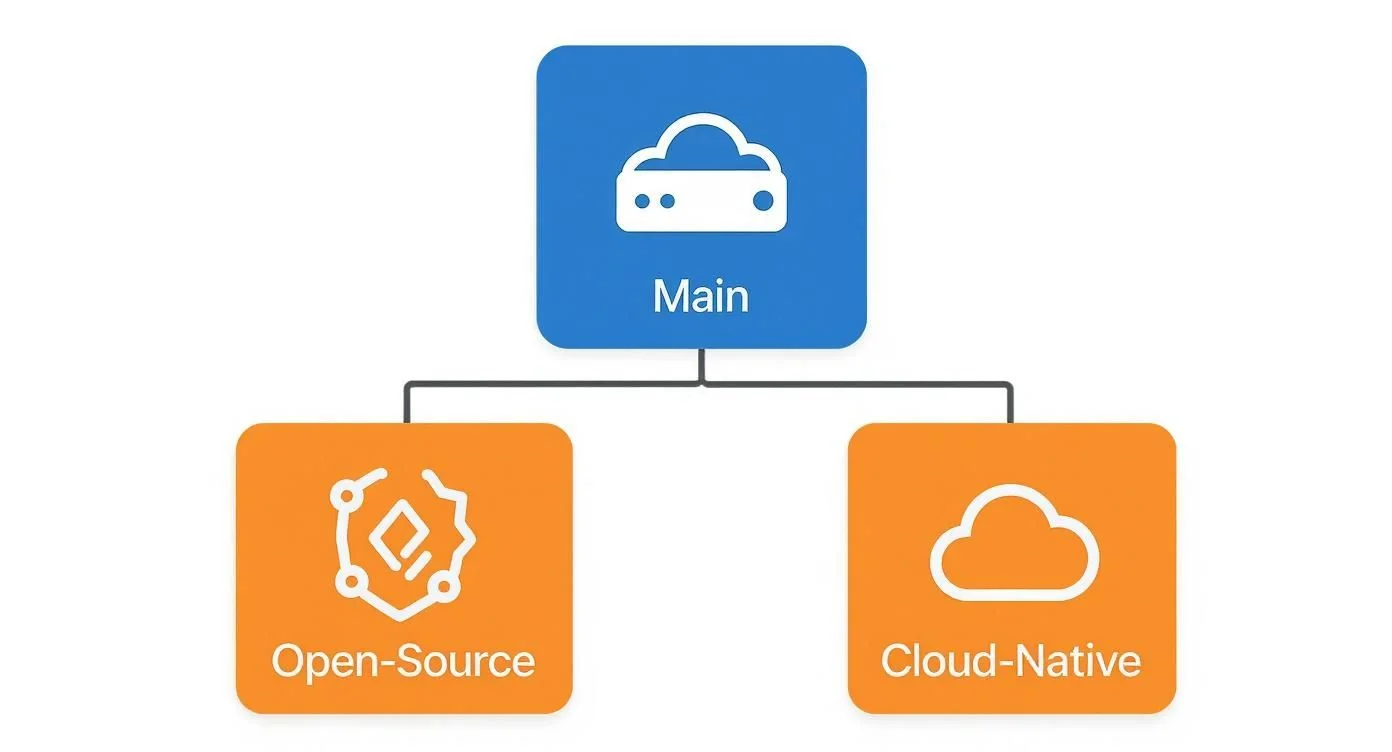
Selecting a data orchestration platform presents a fundamental choice: the flexibility and control of open-source tools versus the managed efficiency and pay-per-use model of cloud-native services.
Neither path is superior; the optimal choice depends on your team’s expertise, architectural requirements, and long-term strategic goals.
The open-source route, dominated by platforms like Apache Airflow, offers maximum control and prevents vendor lock-in. A highly effective modern pattern is running Airflow on Kubernetes via a managed service like Astronomer or AWS MWAA. This hybrid approach combines the power of open source with the operational benefits of a managed infrastructure.
This screenshot of the Apache Airflow UI displays the DAGs view, the central control panel for data workflows.
This interface provides engineers with a comprehensive overview of every workflow’s status, enabling them to monitor recent runs and immediately identify failures. This level of centralized observability is a hallmark of modern data orchestration.
The Dominance of Open Source Hybrids
Open-source tools are prevalent in organizations building durable, long-term data stacks. Gartner’s 2026 predictions indicate that 50% of AI orchestration will use a combination of open-source and proprietary tools. This flexibility is a key driver, as evidenced by Reddit’s migration to an open model, which reduced their vendor lock-in by 70%.
Leveraging an open-source orchestrator on a platform like Kubernetes provides cost-effective scaling and avoids entrapment within a single cloud provider’s ecosystem. It is a strategic decision for maintaining architectural freedom.
For CTOs, this approach simplifies governance. By enforcing declarative assets through dbt integration within Airflow DAGs, organizations create an evergreen, maintainable codebase. This allows for straightforward compliance audits across multi-cloud environments without the need to refactor data silos.
The Power of Cloud-Native and Serverless
Alternatively, cloud-native serverless platforms like AWS Step Functions and Google Cloud Dataflow are deeply integrated into their respective cloud ecosystems, offering a streamlined pay-per-use model ideal for event-driven orchestration.
This is an excellent option for teams prioritizing minimal operational overhead. Instead of managing clusters, you define the workflow logic and pay only for active execution time. This model has proven transformative for workloads like retail ETL, with 2025 Reddit threads praising 50% TCO reductions after migrating from self-hosted systems to serverless orchestrators handling data flows from S3 to BigQuery.
The market reflects this trend. Valued at USD 20.3 billion in 2025, the cloud orchestration market is projected to reach USD 75.4 billion by 2032. You can review the specifics in the latest market analysis.
To maximize the benefits of cloud-native orchestration, leading teams are adopting these practices:
- LLM-Driven Query Generation: Integrating LLM-driven SQL generation enables dynamic queries, allowing pipelines to adapt to new analytical requirements without manual code changes.
- Infrastructure as Code (IaC): Partitioning tasks with Terraform IaC builds resilience against schema evolution and ensures consistent, version-controlled deployments.
- Clear Financial Justification: This approach provides a blueprint for leaders to justify migrations, with well-architected serverless orchestration strategies projecting a two-year payback amidst rising cloud costs.
The decision between open-source and cloud-native data orchestration platforms hinges on your team’s skills, budget, and strategic vision. Open source offers control and flexibility, while cloud-native provides simplicity and operational efficiency.
Advanced Orchestration for Modern Data Architectures
Simple, linear data pipelines are obsolete. Modern data architectures must be dynamic, supporting real-time event processing, decentralized ownership, and the complex requirements of machine learning. The right orchestration strategy is crucial for building a resilient, scalable data platform that delivers tangible business value.
The choice often lies between adaptable open-source frameworks and the managed convenience of cloud-native services.
This is a strategic decision that extends beyond technical implementation, shaping how an organization will manage and scale its critical data assets for years.
Event-Driven Real-Time with Dagster Assets
The transition from nightly batch processing to real-time insight demands a paradigm shift from task-centric to asset-centric orchestration. Dagster spearheads this approach with a model built around the data assets a pipeline produces, not just the code that generates them.
This asset-centric model is ideal for low-latency pipelines, such as those processing Kafka streams into Delta tables. It provides clear visibility into the relationships between data assets, which, as 2025 X discussions highlight, is superior for debugging complex dependencies. This approach has been shown to achieve 99.99% uptime in fintech, according to LinkedIn case studies, by simplifying incident resolution.
By focusing on the state of the data, not just the success or failure of a run, teams can achieve higher reliability.
To handle volatile data streams from sources like IoT, platforms must incorporate features like backpressure management and automated lineage tracking to prevent system overload during data surges. For executives, the ROI is clear: reduced false alerts and 3x faster incident resolution, future-proofing the system against 2026’s projected IoT data growth. For further context, explore these data pipeline architecture examples.
Data Mesh Orchestration with Decentralized Domains
As organizations scale, centralized data teams inevitably become bottlenecks. The Data Mesh architecture addresses this by distributing data ownership to individual business domains. This requires data orchestration platforms that support federated, self-serve environments.
Tools like Prefect or Mage are well-suited for implementing a Data Mesh. They enable domain-owned pipelines with federated catalogs, allowing teams like marketing and finance to manage their own data products while contributing to a unified ecosystem.
- Domain-Owned Pipelines: Each team is directly accountable for the quality and freshness of its data products.
- Federated Catalogs: A shared metadata layer with clear SLAs allows for self-serve data discovery and consumption across domains.
- Outcome-Based Metrics: Defining metrics like data freshness SLAs future-proofs the architecture against regulatory shifts.
As reported in 2025 LinkedIn insights from healthcare consortia, this model can lead to 3x collaboration gains by empowering teams and countering silos. It enables executives to monetize cross-domain assets without central bottlenecks.
Production-Ready MLOps Orchestration Stack
MLOps pipelines involve a complex sequence of experiment tracking, feature versioning, model deployment, and inference monitoring. A robust orchestration stack must integrate this entire lifecycle.
An effective pattern is to sequence MLflow experiments into Prefect or Airflow flows for an end-to-end workflow from feature store to inference. This integrated stack often includes:
- MLflow for Experiment Tracking: Logs parameters, metrics, and model artifacts for reproducibility.
- DVC for Versioning: Provides version control for large datasets and models, akin to Git for code.
- A Feature Store: Centralizes feature engineering to ensure consistency between training and serving.
- CI/CD via GitHub Actions: Automates testing and deployment for both pipeline code and models.
This reproducible stack is why, as highlighted in Domino Data Lab’s 2025 Gartner Visionary status and via X insights, enterprises can achieve 40% faster model deployment. It provides engineering leaders with a resilient blueprint to prototype and ship revenue-generating AI products.
Matching Orchestration Patterns to Platforms
The optimal platform choice depends entirely on the target architecture. There is no single “best” tool, only the best fit for specific goals.
This table maps modern architectural patterns to the platforms and features that enable them.
| Architecture Pattern | Recommended Platform(s) | Key Enabling Feature | Primary Business Outcome |
|---|---|---|---|
| Event-Driven & Asset-Centric | Dagster, Kestra | Declarative, software-defined assets. | 99.99% uptime and 3x faster incident resolution for real-time systems. |
| Data Mesh & Decentralized Domains | Prefect, Mage, Dagster | Support for multi-tenancy, federated governance, and domain isolation. | 3x improvement in cross-team collaboration and faster data product delivery. |
| End-to-End MLOps | Prefect, Airflow, Kubeflow | Strong integrations with MLOps tools (MLflow, DVC) and dynamic workflow generation. | 40% faster model deployment and reproducible AI/ML workflows. |
| Streaming-First Unified Processing | Flink on Databricks | Unified batch/stream APIs and exactly-once processing semantics. | 80% latency reduction for real-time event processing at petabyte scale. |
This table serves as a guide. The final decision must be based on a thorough analysis of your team’s skills, strategic objectives, and the specific data challenges you aim to solve. The right orchestrator becomes the backbone of your entire data strategy.
How to Select the Right Platform for Your Team
Choosing a data orchestration platform is a long-term strategic decision, not just a technical one. A simple feature comparison is insufficient. You must evaluate how a tool will perform under production loads and whether it can scale with your organization’s evolving needs.
To make a durable choice, focus on capabilities that drive business outcomes. Does it support complex AI pipelines? How does it handle governance and compliance? These questions differentiate an adequate tool from a strategic one.
Evaluate Governance and Compliance Capabilities
Governance cannot be an afterthought; it must be embedded directly into orchestration logic. The best data orchestration platforms integrate governance into workflows, making compliance an automated and repeatable process.
As Reddit’s 2025 governance survey reveals, 75% of tools now prioritize business outcomes over rigid standards. When evaluating platforms, look for these critical governance-embedded features:
- Automated PII Redaction: The platform should automatically identify and mask personally identifiable information in transit, ensuring compliance with regulations like GDPR.
- Immutable Audit Trails: A clear, unchangeable log of data access, transformations, and user actions is non-negotiable for auditability.
- Metadata Versioning: Use metadata versioning to enforce data contracts across pipelines, providing CTOs with a defensible architecture for evolving regulations and boosting audit pass rates by 60% in finance.
With these capabilities, compliance becomes a strategic asset that builds trust with customers and regulators.
Assess Support for AI and MLOps Workflows
Modern analytics is increasingly driven by multi-modal AI pipelines, such as Retrieval-Augmented Generation (RAG) workflows that chain together LLMs, vector stores like Pinecone, and human-in-the-loop validation steps. Your orchestrator must manage these complex, multi-step processes.
The ability to chain RAG-enhanced workflows is critical. As seen in 2025 X threads, LLM-driven analytics are replacing traditional BI dashboards, with ad tech companies reducing query times by 70%.
A platform’s ecosystem is a key indicator of its power. Look for deep integrations with essential MLOps tools. Seamless integration with CI/CD tools like GitHub Actions for reproducibility, data quality frameworks like Great Expectations, experiment trackers like MLflow, and data versioning tools like DVC is what enables leaders to scale AI from pilots to production without compromising data provenance.
Analyze Cost Optimization for Hybrid Architectures
As data generation at the edge accelerates, orchestrating hybrid edge-to-cloud flows is critical for cost management. The market for edge management and orchestration is expected to grow from USD 5.2 billion in 2025 to USD 20.3 billion by 2034, according to recent market growth analyses.
Your platform must efficiently orchestrate data ingestion from the edge. Tools like Apache NiFi are endorsed on Reddit in 2025 for their drag-and-drop scaling in IoT, saving 55% on bandwidth in manufacturing, as per LinkedIn reports. A good orchestrator offers a modular framework with geo-fencing and auto-failover to meet latency SLAs under 100ms, preparing leaders for 2026’s decentralized data residency demands.
Using a structured evaluation process helps you select a platform aligned with your long-term goals. Our data engineering RFP checklist provides over 50 essential criteria to build a robust selection framework.
Frequently Asked Questions
As teams delve into data orchestration, several common questions arise. Here are answers to the most frequent inquiries.
What’s the Difference Between Data Orchestration and Workflow Scheduling?
The distinction is fundamental. A scheduler, like Cron, is a simple timer that initiates a single, isolated task at a specific time. It has no awareness of dependencies or the broader process context.
A data orchestration platform is analogous to an air traffic controller managing a complex system of interconnected flights. It understands that Task B cannot start until Task A completes successfully. It manages the entire end-to-end process, handling dependencies, retries, and alerts, and can be triggered by events, such as a file arriving in an S3 bucket.
A scheduler simply starts tasks. An orchestrator manages the entire end-to-end workflow, providing observability and resilience.
Scheduling is merely one component of the comprehensive discipline of orchestration.
Should I Choose an Open-Source Tool or a Cloud-Native Service?
This is a critical decision with no single correct answer. The optimal choice depends on your team’s expertise, budget, and long-term strategy.
-
Choose open-source tools (like Airflow or Dagster) if you require maximum flexibility, control, and want to avoid vendor lock-in. The trade-off is the operational responsibility of managing the underlying infrastructure.
-
Opt for cloud-native services (like AWS Step Functions or Google Cloud Composer) if your priority is rapid development and minimal infrastructure management. These services are often serverless, follow a pay-per-use model, and integrate seamlessly with their parent cloud ecosystem.
Gartner’s prediction that by 2025, 50% of AI orchestration will use a hybrid of open-source and proprietary tools suggests that many organizations are leveraging the best of both worlds.
Can One Platform Handle Both Batch and Streaming Data?
Yes, and this capability is a defining feature of modern platforms. Advanced data orchestration platforms are designed to unify batch and streaming workflows under a single management framework, eliminating the need for separate, siloed systems.
Platforms like Dagster and Prefect are built with this hybrid model in mind. They use concepts like software-defined assets and event-driven triggers to respond to real-time events from sources like Kafka with the same ease as they manage scheduled batch jobs. A truly hybrid system allows a pipeline to be triggered from a message queue, a schedule, an API call, or a manual action—all within a consistent and unified interface.
How Does Data Orchestration Work in a Data Mesh?
In a Data Mesh architecture, orchestration is decentralized to align with the principle of distributed data ownership. Instead of a single, monolithic orchestrator, responsibility is federated across business domains.
In practice, each domain (e.g., Marketing, Sales, Finance) operates its own orchestration instance to manage its data products. The central platform team’s role shifts to that of an enabler, providing standardized tools, templates, and best practices. The domain teams, as the experts on their data, assume responsibility for building and operating their own pipelines. This model scales effectively, fosters data ownership, and accelerates development. As a testament to this, healthcare consortia have reported 3x gains in collaboration by implementing this self-serve model.
Choosing the right data engineering partner is just as critical as picking the right platform. DataEngineeringCompanies.com offers expert-vetted rankings and tools to help you find a consultancy that truly fits your technical needs and business goals. Take a look at our 2025 rankings to make sure your next big data initiative is a success.
Data-driven market researcher with 20+ years in market research and 10+ years helping software agencies and IT organizations make evidence-based decisions. Former market research analyst at Aviva Investors and Credit Suisse.
Previously: Aviva Investors · Credit Suisse · Brainhub · 100Signals
Top Data Engineering Partners
Vetted experts who can help you implement what you just read.
Related Analysis
A Data Lineage Tools Comparison Framework for Engineering Leaders
Cut through the noise with this data lineage tools comparison. Evaluate top vendors on architecture, integration, and pricing for your modern data platform.
A Practical Guide to Snowflake Cost Optimization
Discover proven Snowflake cost optimization strategies. This guide covers compute, storage, and governance to help you reduce your Snowflake bill.
10 Actionable Data Pipeline Testing Best Practices for 2026
Discover 10 actionable data pipeline testing best practices. This guide covers everything from unit tests to chaos engineering for modern data stacks.