A Practical Data Governance Framework Template for 2026
TL;DR: Key Takeaways
- Practical over Theoretical: Avoid complex, academic models. Start with a "Minimum Viable Governance" approach that solves immediate business problems to build momentum.
- The 4 Pillars: A robust framework rests on: 1. Policies/Standards (Rules), 2. Roles/Responsibilities (RACI/Ownership), 3. Processes (Workflows), and 4. Metrics/KPIs (ROI).
- Defined Accountability: Success requires clear roles: Data Owners (Strategy/Budget), Data Stewards (Tactical Quality), and Data Custodians (Technical IT).
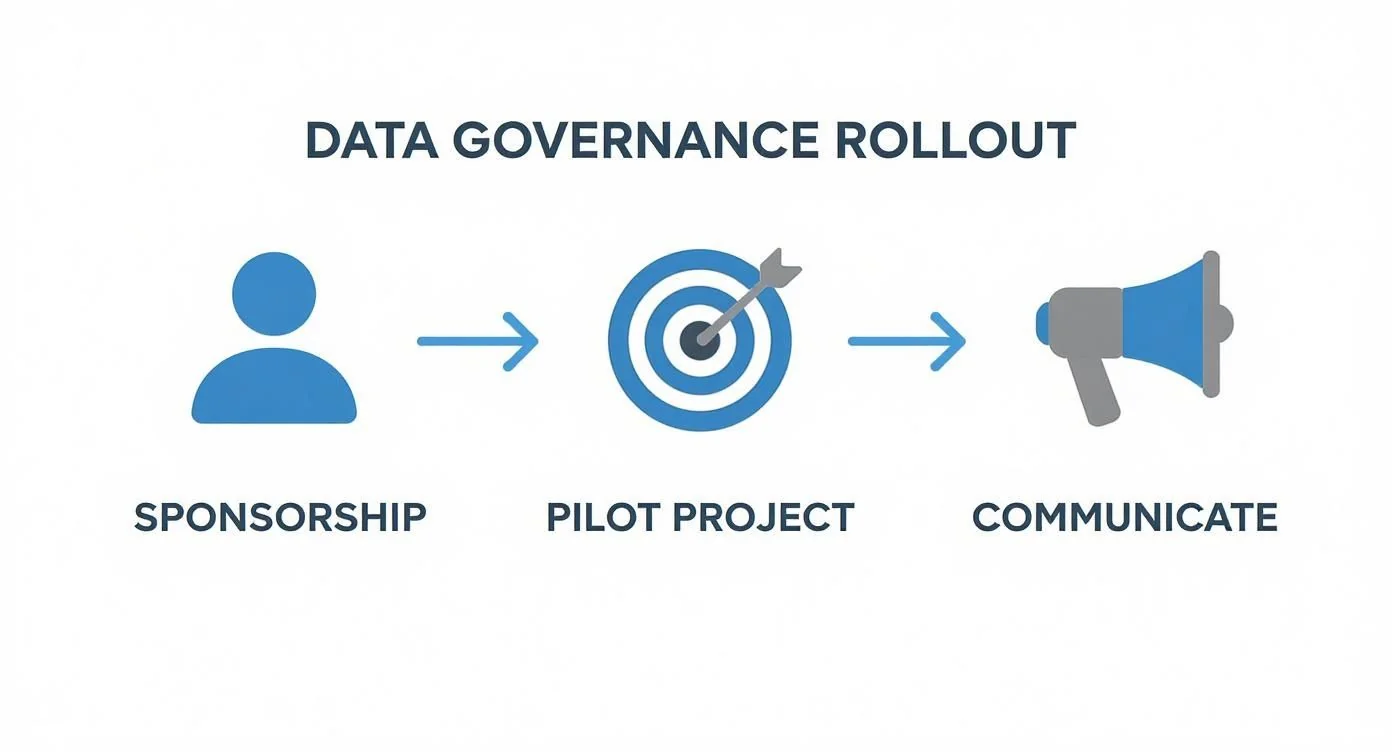
- Phased Rollout: Don't boil the ocean. Secure executive sponsorship, then launch a 90-day pilot on a high-impact domain (e.g., "Customer Data") to prove value.
- Tool Selection: Process comes before technology. Define your governance workflows first, then select tools (Catalogs, Lineage) that automate those specific processes.
Stop downloading theoretical data governance models. This guide provides a practical, actionable template we’ve seen work in real-world scenarios. It’s designed to help you skip dense academic theory and move directly to implementation.
Why Most Data Governance Initiatives Fail
Many data governance initiatives are destined to fail. They launch with complex, top-heavy frameworks that look impressive in a slide deck but collapse upon contact with operational reality. Teams get bogged down defining dozens of roles and writing encyclopedic policies before demonstrating any tangible value.
This is analysis paralysis. The business quickly perceives governance as another layer of bureaucracy, and the project loses momentum. A successful program doesn’t start with a perfect, all-encompassing plan. It begins with a scalable foundation that solves an immediate business problem.
A data governance framework isn’t a static document. It is a living system that must adapt to your organization’s maturity, technology, and strategic priorities. The objective is tangible progress, not theoretical perfection.
This guide is built around an actionable data governance framework template. It’s designed for phased, customized rollouts, enabling quick wins that build the momentum necessary for broader adoption.
The Business Case for a Practical Framework
Effective data governance has never been more critical. In 2026, a significant majority of corporate leaders identify it as a top priority, often ranking it higher than emerging technologies like generative AI. The reason is clear: the returns are tangible, from improved data quality for analytics to streamlined regulatory compliance.
The risks of inaction are equally real. Non-compliance with regulations like GDPR can result in fines up to £17.29 million or 4% of global revenue.
A practical framework helps manage these risks and unlock opportunities without introducing unnecessary complexity. It serves as a launchpad for a program that delivers measurable results.
Core Components of a Data Governance Framework
Before deploying the template, understand its core pillars. Each is designed for clarity and action, creating a solid structure for managing data assets. This table provides a high-level overview.
| Component | Purpose and Key Elements |
|---|---|
| Policies & Standards | Establishes the high-level rules for data: quality standards, security classifications, access protocols, and data lifecycle management. |
| Roles & Responsibilities | Defines accountability using a RACI matrix for roles like Data Owners, Stewards, and Custodians to clarify duties and decision rights. |
| Processes & Workflows | Outlines standard operating procedures for critical activities, including data issue resolution, new data source onboarding, and metadata management. |
| Metrics & KPIs | Answers the question: “Is this working?” Establishes KPIs to track data quality improvements, compliance adherence, and business ROI. |
A clearly defined structure is invaluable when engaging vendors or partners. These pillars can inform your selection process. Our guide on how to create a data engineering RFP template provides a useful structure for this.
Deconstructing the Framework Components
A data governance framework template is just a document until you understand its functional components. View it as a modular blueprint for building trust in your data. Each piece has a specific role, and together they transform data from a chaotic liability into a strategic asset.
Let’s dissect the pillars of a modern, effective framework, moving from high-level rules to tactical implementation with practical examples.
Crafting Clear Data Policies
Think of data policies as the constitution for your data ecosystem—high-level principles defining how data is managed, accessed, and used. The key is to keep them concise and directly linked to business objectives, not technical jargon.
Focus on critical areas that carry the most risk or offer the greatest opportunity.
- Data Quality Standards: Define what “good” means for critical data domains like “Customer” or “Product.” A practical standard might be: “All customer records must have a valid email address and a 98% field completion rate for key attributes.”
- Data Security and Classification: Define sensitivity levels (e.g., Public, Internal, Confidential) and specify handling requirements. For example: “All data classified as Confidential must be encrypted at rest and in transit.”
- Data Lifecycle Management: Establish rules for data retention, archival, and deletion. This is critical for controlling storage costs and ensuring regulatory compliance.
Defining Roles and Responsibilities
Without clear ownership, data governance remains a theoretical exercise. Assigning roles creates accountability. While titles may vary, the core functions are universal.
- Data Owner: A senior business leader (e.g., VP of Sales for sales data) who is ultimately accountable for the quality, security, and value of a specific data domain. They oversee strategic decisions and budget.
- Data Steward: A subject matter expert who is responsible for the tactical, hands-on management of data. This is often a business user, like a Senior Marketing Analyst, who understands the data’s context and use cases.
- Data Custodian: An IT or data engineering professional who manages the technical systems where data resides. They implement security controls and maintain infrastructure but do not own the data itself.
A RACI (Responsible, Accountable, Consulted, Informed) matrix is a simple, effective tool for eliminating ambiguity.
Pro Tip: Don’t attempt to document every data process at once. Select one high-impact activity, like onboarding a new data source, and build a RACI for it. Getting this single process right prevents future conflicts and delays.
This sample RACI for onboarding a new marketing data source clarifies responsibilities and workflows.
Sample RACI Matrix for New Data Source Onboarding
| Activity/Task | Data Owner | Data Steward | Data Engineer | Business Analyst |
|---|---|---|---|---|
| Approve new data source request | A | R | I | C |
| Define business requirements | C | A | I | R |
| Assess data quality of source | I | R | C | C |
| Build data ingestion pipeline | I | C | R | I |
| Validate data post-ingestion | C | R | A | C |
| Document new source in catalog | I | R | C | I |
| Grant user access to data | A | R | C | I |
This level of clarity distinguishes a functional data governance program from a purely theoretical one.
Establishing Stewardship and Catalogs
Data Stewardship is the operational core of governance. Stewards are the frontline guardians of data quality, responsible for defining business terms, resolving inconsistencies, and ensuring policies are followed within their domains.
To be effective, they need a Data Catalog—a central, searchable inventory of all data assets. A modern catalog serves as a bridge between business and IT.
Essential catalog features include:
- Business Glossary: A repository of officially approved, plain-language definitions for key business terms.
- Data Lineage: A visual map tracing data’s journey from origin through transformations to its final destination. This is indispensable for impact analysis and troubleshooting.
- Metadata Management: Rich context about the data, including its owner, steward, quality scores, and security classification.
Implementing Access Controls and Metrics
Access Controls enforce data security policies. The guiding principle should be least privilege: users should only have access to the data they absolutely need to perform their jobs. Role-Based Access Control (RBAC) is the standard, where permissions are assigned to roles (e.g., “Sales Analyst”) rather than individuals.
Finally, measurement is non-negotiable. Performance Metrics prove the value of the program and justify continued investment. Focus on business impact.
- Defensive Metrics: Demonstrate risk reduction (e.g., “40% decrease in compliance audit findings”).
- Offensive Metrics: Highlight value creation and efficiency (e.g., “15-hour reduction in weekly data cleaning time for analysts”).
- Adoption Metrics: Track program integration (e.g., “Percentage of critical data elements with an assigned steward”).
Adapting the Framework to Your Organization
A downloaded data governance framework template is a starting point, not a final solution. Treating it as a rigid, one-size-fits-all document is a setup for failure. The template becomes “shelfware”—an artifact with no real-world impact.
The objective is to adapt the template into a living system that fits your organization’s existing workflows, rather than imposing a heavy, bureaucratic process.
Tailoring Governance to Your Company’s Scale
The governance needs of a 50-person startup differ fundamentally from those of a 5,000-employee enterprise. Applying a corporate-grade model to a small company stifles agility, while a startup’s lean approach would be inadequate for a large organization.
For Startups and Small Businesses (<200 Employees):
- Implement “Minimum Viable Governance.” Focus on one or two critical data domains, such as “Customer” or “Sales.”
- Consolidate roles. A single tech-savvy business lead can often serve as both Data Owner and Steward initially.
- Start with a business glossary. A simple wiki page documenting the top 20-30 business metrics is a powerful first step to establish a common language.
For Mid-Sized Companies (200-2,000 Employees):
- Formalize stewardship. Officially designate Data Stewards from business units and make it a defined part of their role.
- Establish a lean governance council. A small, cross-functional group that meets quarterly to prioritize initiatives and resolve data conflicts.
- Invest in a basic data catalog. Move beyond spreadsheets and wikis. Lightweight, automated cataloging tools are necessary to map data assets and ownership at this scale.
For Large Enterprises (>2,000 Employees):
- Adopt a federated model. A centralized governance team sets standards and policies, while domain-specific teams manage their own data assets.
- Automate governance controls. Manual oversight is not feasible. Rely on automated tools for access control, data masking, and quality monitoring.
- Integrate governance into the M&A playbook. Make data governance a core component of due diligence and post-merger integration to prevent the creation of new data silos.
The goal is not to achieve the highest level of governance maturity. The goal is to implement the right level of governance for your organization’s current needs, allowing it to evolve as you grow.
Aligning the Framework with Your Modern Data Stack
A governance framework is ineffective if it doesn’t integrate with your technology stack. Enforcing generic policies without leveraging the native features of your cloud data platform is futile.
- On Snowflake: Map your data classification policy directly to Object Tagging. Detail the use of Dynamic Data Masking and Row-Access Policies in your access control rules to protect PII.
- On Databricks: Center your framework around the Unity Catalog. Define stewardship and cataloging processes as workflows within Unity Catalog, using its built-in lineage for audits and setting granular access controls.
- On Google BigQuery: Integrate policies with Google Cloud’s IAM and Data Catalog. Specify how BigQuery column-level security and Policy Tags in Data Catalog will enforce rules for sensitive data at scale.
This platform-aware approach makes a framework practical and enforceable. For regulated industries like finance and healthcare, platform-native controls are essential for compliance. Our guide on data analytics in the insurance industry further explores this topic. By embedding technical controls into documented processes, you transform your data governance framework template from a static document into an operational system.
Turning Your Framework into a Reality: The Rollout Plan
A well-designed data governance framework is useless without effective implementation. Avoid a “big bang” approach that attempts to govern everything at once. A strategic, phased rollout builds momentum and demonstrates value early.
This is fundamentally a change management process. You are shifting how your organization perceives and uses data.
Secure Executive Sponsorship
Before writing a single policy, secure a dedicated executive sponsor. This must be a leader who views data governance as a business enabler, not a compliance burden.
When pitching for sponsorship, focus on business outcomes:
- To the CFO: Emphasize mitigating regulatory fines and accelerating the financial close process.
- To the CMO: Frame it as creating a single source of truth for customer data to increase campaign ROI.
- To the COO: Focus on operational efficiency gains from eliminating redundant data and manual reporting.
The sponsor’s role is to break down political barriers, secure budget, and reinforce the strategic importance of the initiative. Without this support, the program is unlikely to succeed.
Assemble a Lean Governance Council
Form a small, cross-functional governance council. Avoid creating a bloated bureaucracy. The council’s role is to:
- Prioritize data governance initiatives based on business impact.
- Serve as the final authority on data definition and ownership disputes.
- Approve high-level data policies before enterprise-wide rollout.
The council should include the executive sponsor, key business data owners, and representation from the data/IT team to ensure decisions are both strategic and technically feasible.
Select a High-Impact Pilot Project
Resist the urge to solve all data problems simultaneously. Choose one well-defined pilot project with a high probability of success, a clear business problem, an engaged stakeholder, and a scope that can be delivered within 90 days.
A common example is tackling the “Customer” data domain. If Sales and Marketing have conflicting customer lists, the pilot can focus on defining “customer,” assigning stewards, setting quality rules, and establishing a single, trusted source.
The right pilot project is critical. An early, visible win creates the success story needed to justify program expansion and secure broader organizational buy-in.
Develop a Communication Plan
Communicate progress continuously as you execute the pilot. The goal is to demystify data governance and demonstrate its tangible benefits.
Celebrate all wins, no matter how small:
- Did you reduce the time to generate a weekly sales report from four hours to ten minutes? Announce it.
- Did you merge two conflicting customer databases? Explain how this will improve marketing campaign effectiveness.
By framing every update around solving a business problem, you change the narrative. Data governance becomes a valuable service that enables better decision-making, not a restrictive set of rules.
A solid internal framework also provides a competitive advantage. Globally, data governance approaches vary; 74 countries have open data policies, but only 30 have robust regulations. This fragmentation makes a strong internal framework a strategic differentiator. You can explore the global data governance landscape to understand regional differences.
Navigating Tools and Common Pitfalls
A common mistake is to focus on technology selection before defining processes. Your process should dictate the tool, not the other way around. Defining your processes first clarifies exactly what capabilities you need, preventing over-investment in complex, feature-rich platforms.
The data governance market is projected to grow from $5.38 billion in 2026 to $18.07 billion by 2032, driven by regulatory pressures and the need for high-quality data for AI. This growth creates a crowded vendor landscape, making a process-first strategy essential. You can read more about the data governance market trends shaping this space.
Choosing the Right Technology
When you are ready to evaluate vendors, lead the conversation with a checklist based on your defined needs.
Focus RFP questions on core capabilities:
- Automated Data Cataloging: “How does your tool discover and profile assets across our specific tech stack, including Snowflake, Databricks, and our legacy systems?”
- Data Lineage Mapping: “Demonstrate end-to-end lineage using a complex, real-world example from our environment.” The output must be understandable to both business analysts and engineers.
- Policy Enforcement: “How does the tool translate our written policies into automated rules within our data platforms?”
This phased approach ensures technology investments are made only when necessary.
As the graphic illustrates, securing sponsorship and proving value through a pilot project builds the justification for larger technology investments.
Avoiding Common Governance Pitfalls
Beyond premature technology selection, several other common traps can derail governance programs.
Key Insight: A data governance framework that slows down the business will be ignored. The goal is to enable faster, more confident decisions, not to create bureaucratic roadblocks.
Avoid these common mistakes:
- Creating Policies That Inhibit Innovation: Governance should establish guardrails, not cages. Overly restrictive policies that prevent analysts from accessing data for exploration will be counterproductive.
- Failing to Connect to Business Outcomes: Translate technical goals into business impact. Instead of “improving data quality,” aim to “reduce customer churn by 5% by providing the sales team with more accurate data.”
- Treating Governance as a One-Off Project: A data governance framework is a living program that requires continuous attention, communication, and adaptation as the organization and its data evolve.
Modern platforms like Snowflake and Databricks offer powerful native governance features that can serve as an effective starting point, potentially delaying the need for a dedicated third-party tool. Our guide on the governance capabilities of Snowflake vs Databricks details how to leverage these built-in functionalities.
By focusing on process first, linking every effort to business value, and avoiding these common pitfalls, you can build a sustainable program and make smarter technology investments when the time is right.
Frequently Asked Questions
Even the most practical data governance template will generate questions during implementation. Here are direct answers to common queries from teams moving from planning to execution.
How Do I Get Business Users to Actually Care?
Stop using the term “data governance.” Business users in marketing or sales are not motivated by policies or compliance frameworks; they are motivated by solving problems that make their jobs easier.
Connect your governance work directly to their daily pain points. Instead of announcing a new data quality policy, launch a pilot to create a master “Customer” data set. When the sales team gains a single, reliable view of their accounts, they will become your strongest advocates.
Frame every initiative as a solution to a specific business problem. A success story about reducing report-building time by 30% by eliminating conflicting data sources is far more persuasive than any policy document.
Ultimately, speak their language. When you can draw a direct line from your program to improved lead scoring or faster business insights, you have secured their buy-in.
What Is the Difference Between Data Governance and Data Management?
Data management builds the infrastructure (roads and bridges), while data governance sets the rules of the road (traffic laws and signs). They are interdependent.
- Data Management encompasses the technical, hands-on work: building data pipelines, managing cloud storage, configuring security, and running ETL/ELT jobs. It is the operational implementation.
- Data Governance is the strategic layer that provides the framework for data management. It defines accountability, establishes quality standards, and sets the processes for using data securely and ethically.
In short, data management is the execution, while data governance is the direction and oversight. A data engineer building a pipeline is practicing data management; the standards they follow for quality and security are dictated by governance.
Should We Build Our Own Tools or Buy a Solution?
For most organizations, a hybrid approach is the most effective path. Maximize the value of your existing tools before considering a large-scale platform purchase.
- On Snowflake: Master native features like object tagging, dynamic data masking, and row-access policies.
- On Databricks: Center your governance efforts around the Unity Catalog for lineage, access control, and discovery.
- For documentation: Start with a well-organized Confluence or SharePoint space for your initial business glossary and steward directory.
This “build-light” approach forces you to define your processes first. Let your operational maturity drive technology acquisition. Only consider commercial solutions when manual processes become a clear bottleneck, such as when you need automated lineage tracing across multiple complex systems.
How Do We Measure the ROI of a Data Governance Program?
Demonstrate how governance impacts the bottom line by measuring both defensive and offensive value. Establish a baseline for these metrics before you begin and track them quarterly to create a compelling narrative of progress.
| ROI Category | Key Metrics to Track |
|---|---|
| Defensive ROI | • Time saved by analysts no longer manually cleaning and reconciling data. • Reduced cloud storage costs from eliminating redundant and trivial data. • Quantified risk reduction from avoiding potential compliance fines. |
| Offensive ROI | • Faster time-to-insight for critical analytics projects. • Measurable lift in sales from cross-selling campaigns powered by trusted data. • Higher marketing campaign ROI from more accurate audience segmentation. |
Finding the right partner is as critical as having the right framework. At DataEngineeringCompanies.com, we provide independent, data-driven rankings and reviews of top data engineering firms to help you select the best consultancy with confidence. Find your ideal data engineering partner today.
Data-driven market researcher with 20+ years in market research and 10+ years helping software agencies and IT organizations make evidence-based decisions. Former market research analyst at Aviva Investors and Credit Suisse.
Previously: Aviva Investors · Credit Suisse · Brainhub · 100Signals
Top Data Engineering Partners
Vetted experts who can help you implement what you just read.
Related Analysis
Data Governance vs. Data Management: A Practical Comparison
Understand the critical differences in the data governance vs data management debate. Learn how to align strategy and operations for a modern data platform.
Data Governance Consulting: A Practical Guide to Implementation
Explore data governance consulting to learn how experts deliver results, pricing, and how to hire the right firm.
A Practical Guide to Hiring Data Governance Consultants
Hiring data governance consultants? This guide unpacks their roles, costs, and selection criteria to help you find the right partner for your modern data stack.